Placement of Saturn in Twelve Rashis

In Vedic Astrology, Saturn, or Shani, is one of the most important planets for understanding discipline, responsibility, karma, patience, hard work, delays, and long-term achievements. Saturn is often considered a challenging planet because its influence can bring obstacles, restrictions, responsibilities, and situations that require patience. However, Saturn is not simply a planet of suffering. It is also the planet that teaches persistence, maturity, humility, discipline, and the value of consistent effort.
The Rashi placement of Saturn in a birth chart can reveal how a person approaches responsibility, work, discipline, relationships, material ambitions, and difficult circumstances. Saturn takes approximately 29.5 years to complete its journey through the zodiac, spending roughly two and a half years in each Rashi. Its placement becomes particularly significant when considered together with the house it occupies, its dignity, aspects, conjunctions, Nakshatra, retrograde status, and the strength of the Ascendant and its lord.
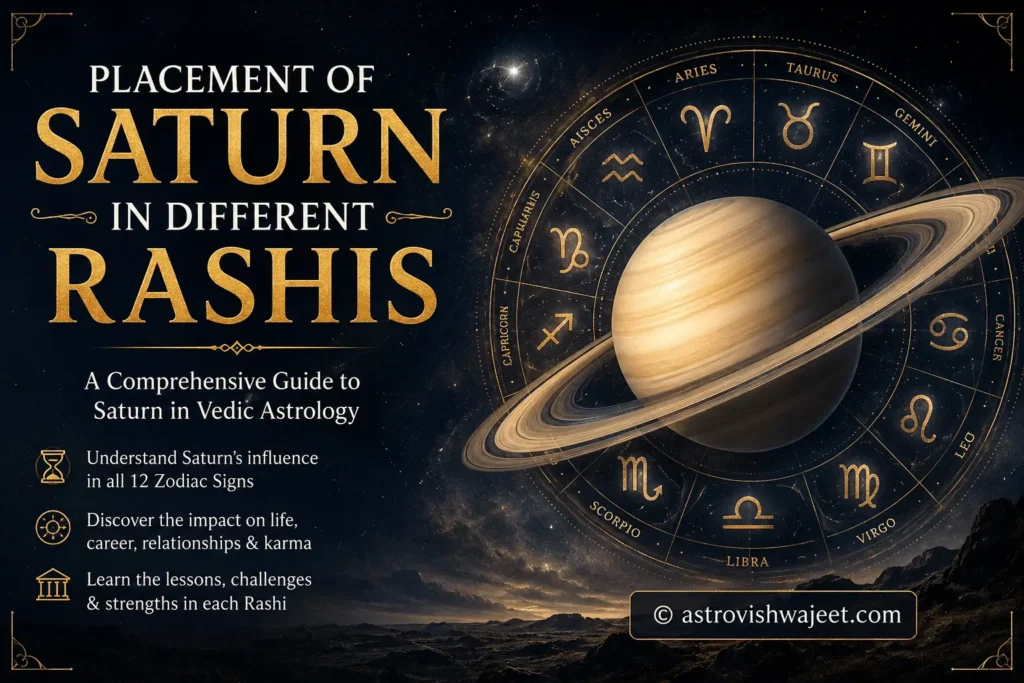
In this article, we will explore the placement of Saturn in all twelve Rashis and understand how Saturn may express its energy in each sign.
Saturn in Aries
Aries is ruled by Mars, while Saturn and Mars have very different planetary qualities. Aries represents initiative, courage, independence, competition, and action. Saturn, on the other hand, represents patience, restriction, structure, and careful planning.
Saturn is considered debilitated in Aries, with its deepest debilitation traditionally placed at 20 degrees of Aries. This placement can create a conflict between the desire to act quickly and Saturn’s tendency to slow things down.
A person with Saturn in Aries may experience delays in achieving personal ambitions. They may want immediate results but repeatedly encounter situations that force them to wait, plan, and develop patience. Early life can sometimes involve frustration related to authority, career, independence, or self-expression.
However, Saturn in Aries can become productive with maturity. The individual may gradually learn how to combine Aries’ courage with Saturn’s discipline. Instead of acting impulsively, they can develop the ability to take calculated risks and pursue long-term goals.
This placement can also teach an important karmic lesson: action becomes more effective when it is supported by patience and planning.
Saturn in Taurus
Taurus is ruled by Venus and represents wealth, stability, possessions, family values, food, comfort, and material security. Saturn generally performs well in Taurus because both Saturn and Taurus appreciate stability, practicality, persistence, and tangible results.
Saturn in Taurus can create a strong desire for financial security. The person may be cautious with money and reluctant to take unnecessary financial risks. Wealth may accumulate slowly, but consistent effort can produce lasting results.
There may be responsibilities related to family, finances, property, or material resources. During younger years, the person may feel that financial progress is slower than expected. However, Saturn rewards sustained effort, and financial stability can improve considerably with age.
This placement can also make a person practical and realistic. They may prefer things that have long-term value rather than temporary pleasures.
The challenge is becoming overly conservative or fearful of change. Saturn in Taurus benefits from learning when to preserve stability and when to adapt.
Saturn in Gemini
Gemini is ruled by Mercury and represents communication, learning, writing, networking, curiosity, business skills, and intellectual activity. Saturn in Gemini can make the mind serious, analytical, cautious, and structured.
People with this placement may think carefully before speaking. They may not be naturally expressive during their early years, but with experience they can develop excellent communication skills.
Saturn in Gemini can be favorable for professions involving writing, research, accounting, administration, technology, analysis, documentation, or structured communication. The person may prefer factual and practical information over speculation.
There can sometimes be fear of making mistakes while communicating. A person may repeatedly edit their thoughts before expressing them. In some cases, this can create hesitation.
With maturity, however, Saturn can turn this caution into intellectual discipline. The person may become a thoughtful communicator whose words carry authority because they speak after careful consideration.
Saturn in Cancer
Cancer is ruled by the Moon and represents emotions, home, family, mother, security, nurturing, and inner comfort. Saturn’s dry and detached nature can find it difficult to express itself naturally in emotional Cancer.
Saturn in Cancer may indicate a serious emotional nature. The individual may take family responsibilities very seriously and may have experienced circumstances that required emotional maturity at an early age.
There can be a strong sense of duty toward family members. Sometimes the person may feel emotionally restricted or find it difficult to openly express vulnerability.
The relationship with the mother or the experience of home and emotional security can become an important area of learning, depending on the house placement and other planetary influences.
The positive side of this placement is emotional endurance. Such individuals can develop remarkable inner strength because they learn to manage emotions rather than being controlled by them.
Saturn in Cancer teaches the importance of creating emotional security through responsibility, maturity, and healthy boundaries.
Saturn in Leo
Leo is ruled by the Sun, while Saturn and the Sun have an uncomfortable relationship in Vedic Astrology. Leo represents authority, confidence, leadership, creativity, recognition, children, and self-expression.
Saturn in Leo can create lessons around authority and recognition. A person may work hard for appreciation but feel that recognition comes later than expected.
There may be challenges involving relationships with authority figures, bosses, or the father, depending on the complete horoscope. The individual may also struggle between wanting recognition and feeling uncomfortable with being in the spotlight.
However, Saturn in Leo can produce disciplined leadership. Instead of seeking authority merely for status, the person can eventually learn to lead through experience, responsibility, and competence.
This placement can become particularly powerful as the person grows older. Leadership qualities may become stronger when confidence is built through actual accomplishments rather than external validation.
Saturn in Virgo
Virgo is ruled by Mercury and represents analysis, service, organization, health routines, practical skills, detail, and problem-solving. Saturn generally appreciates Virgo’s systematic and practical nature.
Saturn in Virgo can produce a highly disciplined and methodical personality. The person may pay close attention to details and prefer organized working environments.
This placement can be beneficial for careers involving accounting, administration, engineering, research, medicine, analytics, auditing, technology, or other fields requiring precision.
One possible challenge is excessive perfectionism. Saturn already tends to focus on mistakes and responsibilities, while Virgo can intensify the desire to make everything perfect. The person may become overly critical of themselves.
Learning to distinguish between genuine improvement and unnecessary self-criticism is important.
When positively expressed, Saturn in Virgo can create someone who is dependable, organized, technically skilled, and capable of handling complicated responsibilities over long periods.
Saturn in Libra
Libra is ruled by Venus and is the sign where Saturn is traditionally considered exalted. Saturn reaches its deepest exaltation at 20 degrees of Libra.
Libra represents balance, relationships, justice, contracts, diplomacy, social interaction, and partnerships. Saturn’s qualities of fairness, structure, discipline, and responsibility can work particularly well in this sign.
Saturn in Libra can give a strong sense of justice and responsibility toward others. The person may take commitments seriously and prefer stable, mature relationships.
This placement can also be favorable for careers involving law, administration, government, negotiation, management, architecture, business, or social institutions.
Relationships may develop slowly. The individual may not rush into commitment and may prefer relationships that have long-term potential.
Saturn in Libra is often associated with learning the value of balance. The person may experience important lessons through partnerships, contracts, responsibilities, and social obligations.
When strong and supported by other factors in the horoscope, Saturn in Libra can produce excellent judgment, patience, diplomacy, and long-term professional success.
Saturn in Scorpio
Scorpio is ruled by Mars and represents transformation, secrecy, research, psychology, joint resources, hidden matters, and deep emotional experiences.
Saturn in Scorpio can create a serious and intense personality. The individual may not easily trust others and may prefer to understand situations deeply before becoming involved.
This placement can bring lessons through shared finances, emotional attachments, inheritance, intimate relationships, or circumstances involving sudden transformation, depending on the house placement.
Saturn in Scorpio can also be excellent for research-oriented activities. The person may possess patience for investigating subjects that others find difficult or complicated.
There may be a tendency to hold onto resentment or past experiences. Learning how to process difficult experiences without becoming emotionally rigid is important.
With maturity, Saturn in Scorpio can produce tremendous psychological endurance. The individual may become capable of surviving difficult circumstances and rebuilding their life through patience and determination.
Saturn in Sagittarius
Sagittarius is ruled by Jupiter and represents philosophy, higher education, spirituality, ethics, long-distance travel, religion, law, and wisdom.
Saturn in Sagittarius can create a serious approach toward philosophy and belief systems. Rather than accepting ideas blindly, the person may want practical evidence and personal experience.
Education may follow a non-linear path in some cases, with delays or responsibilities affecting higher studies. However, Saturn can eventually produce deep knowledge through sustained learning.
This placement may also make the individual serious about ethics and principles. They may develop a strong sense of responsibility toward their beliefs.
There can sometimes be conflict between traditional principles and personal experience. Saturn teaches the person to develop wisdom through responsibility rather than simply collecting information.
Saturn in Sagittarius can become particularly valuable for people involved in teaching, law, philosophy, administration, research, spirituality, or structured educational work.
Saturn in Capricorn
Capricorn is ruled by Saturn itself, making Saturn particularly comfortable in this sign. Capricorn represents career, authority, responsibility, ambition, institutions, social status, and long-term achievement.
Saturn in Capricorn can create a highly practical and ambitious personality. The individual may be willing to work for years toward a goal without expecting immediate rewards.
Career development may initially feel slow, but Saturn’s influence often emphasizes gradual and lasting progress. The person may gain authority through experience rather than shortcuts.
These individuals may take professional responsibilities seriously and can be dependable in demanding environments.
One challenge is becoming too focused on work and achievement. Saturn in Capricorn needs to remember that professional success is only one part of life.
When well placed, this Saturn can produce strong organizational ability, leadership through experience, patience, and substantial long-term achievements.
Saturn in Aquarius
Aquarius is traditionally ruled by Saturn and represents society, networks, innovation, large organizations, humanitarian interests, technology, communities, and collective goals.
Saturn in Aquarius can be particularly strong because Saturn is operating in one of its own Rashis.
This placement often gives a practical understanding of systems and organizations. The person may be interested in improving existing structures rather than simply following them.
They may work well in large organizations, technology-related fields, social institutions, research, administration, or community-oriented projects.
Saturn in Aquarius can also create a somewhat detached social personality. The individual may have many acquaintances but maintain a smaller circle of genuinely trusted relationships.
There can be a strong sense of social responsibility. The person may understand that meaningful change requires patience and organized effort.
This placement often becomes more productive with age because Saturn’s lessons become clearer through experience.
Saturn in Pisces
Jupiter rules Pisces and represents spirituality, imagination, compassion, intuition, dreams, sacrifice, and the subconscious.
Saturn in Pisces combines structure with a sign that is naturally fluid and imaginative. This can create an interesting internal conflict between the need for boundaries and the desire to escape limitations.
The person may take spirituality seriously but may go through periods of uncertainty before developing a mature philosophy.
Saturn in Pisces can also create responsibility toward people who need support. The individual may be compassionate but must learn not to carry every person’s problems as their own.
This placement benefits greatly from establishing boundaries and practical routines.
In professional life, Saturn in Pisces can support careers involving institutions, spirituality, counseling, research, creative work, social service, or fields where imagination needs to be combined with discipline.
The greatest lesson is learning how to give form to dreams. Saturn teaches Pisces that inspiration becomes meaningful when it is supported by consistent action.
Saturn’s Results Depend on More Than the Rashi
Although Saturn’s Rashi placement is important, it should never be interpreted in isolation. Vedic Astrology considers several other factors before determining the complete results of Saturn.
The house placement is particularly important. For example, Saturn in Libra can produce very different experiences depending on whether it occupies the first, fourth, seventh, tenth, or another house.
The Ascendant and Ascendant lord must also be examined. Saturn can be a benefic, malefic, or mixed functional planet depending on the Ascendant.
The Nakshatra occupied by Saturn adds another layer of interpretation. Its Nakshatra lord, Pada, and planetary relationships can significantly modify the results.
Conjunctions and aspects also matter. Saturn’s conjunction with Jupiter, Mars, Venus, Mercury, the Sun, Moon, or Rahu can produce very different results.
Finally, the Vimshottari Dasha and major transits determine when Saturn-related themes are likely to become more prominent.
Saturn and the Principle of Delayed Results
One of the most important principles associated with Saturn is delay rather than denial. However, this phrase should not be interpreted as an absolute rule. Saturn’s actual results depend on the entire horoscope.
Saturn often requires a person to demonstrate patience and consistency before giving lasting results. Someone with a strong Saturn may experience slow progress but eventually build something that remains stable for many years.
This is why Saturn is often associated with maturity. Its influence becomes easier to understand as a person gains life experience.
The lessons of Saturn can include:
- Patience
- Discipline
- Responsibility
- Humility
- Persistence
- Realistic expectations
- Respect for time
- Acceptance of consequences
- Long-term planning
- Learning from difficulties
Saturn does not necessarily prevent success. Instead, it often asks the individual to build success on a stronger foundation.
Saturn in Different Rashis and Personal Growth
Every Saturn placement has both challenges and opportunities. A debilitated Saturn is not automatically disastrous, just as an exalted Saturn does not guarantee success. The complete birth chart must always be considered.
Saturn’s deeper purpose in Vedic Astrology is connected with karma, responsibility, time, and maturity. Its placement can show where a person may need to develop patience and where life may demand greater responsibility.
For example, Saturn in Aries may teach controlled action, while Saturn in Taurus can teach financial patience. Saturn in Gemini can develop disciplined communication, while Saturn in Cancer can teach emotional maturity. Saturn in Leo can transform the approach to authority, while Saturn in Virgo can develop practical discipline.
Saturn in Libra emphasizes balance and responsibility in relationships and society. Saturn in Scorpio develops endurance through transformation. Saturn in Sagittarius can deepen philosophical understanding, while Saturn in Capricorn and Aquarius can strongly emphasize responsibility, institutions, career, and collective systems.
Saturn in Pisces teaches the importance of combining compassion and imagination with boundaries and practical discipline.
Conclusion
The placement of Saturn in different Rashis provides valuable insight into how a person experiences responsibility, discipline, delays, ambition, and long-term growth. Saturn’s energy is rarely about instant gratification. Its lessons are generally connected with patience, persistence, maturity, and the consequences of one’s actions.
Saturn may create difficulties in the areas associated with its placement, but those difficulties can also become the source of significant personal development. With time, experience, and conscious effort, Saturn’s restrictive qualities can transform into discipline, wisdom, resilience, and lasting achievement.
For an accurate interpretation, Saturn’s Rashi should always be studied alongside the Ascendant, house placement, Nakshatra, planetary aspects, conjunctions, dignity, retrograde status, Shadbala, Dasha periods, and current transits.
Ultimately, Saturn teaches one of the most important principles of Vedic Astrology: lasting results are usually built through time, responsibility, patience, and consistent effort.