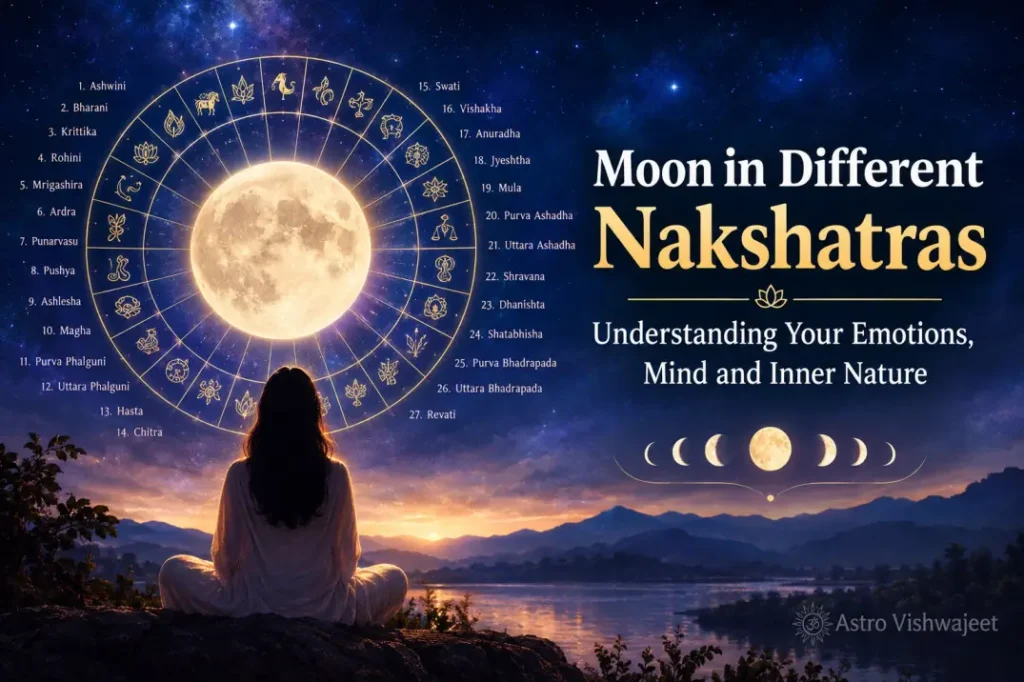
Moon in Different Nakshatras: Understanding Your Emotions, Mind and Inner Nature

In Vedic Astrology, the Moon is one of the most important planets to understand. It represents the mind, emotions, feelings, memories, habits, comfort, mother, emotional security, and the way we respond to the world around us.
While your Moon sign tells us a great deal about your emotional nature, your Moon Nakshatra can take the interpretation much deeper.
The Nakshatra in which your Moon is placed can reveal how you process emotions, what makes you feel secure, how you react under pressure, what kind of relationships you seek, and even the patterns that quietly influence your decisions.
There are 27 Nakshatras, or lunar constellations, used in Vedic Astrology. Each Nakshatra has its own deity, symbolism, planetary ruler, energy, and psychological qualities. Since the Moon moves quickly through the zodiac, it spends roughly one day in each Nakshatra. This makes the Moon’s Nakshatra especially personal and important in understanding the mind.
In this article, we will explore the Moon in different Nakshatras and understand what each placement can indicate.
Why Is the Moon Nakshatra So Important?
The Moon reflects the inner world. It shows what happens inside us when nobody is watching.
Two people may have the same Moon sign but behave very differently emotionally because their Moons are placed in different Nakshatras.
For example, one person may need freedom, adventure, and constant movement to feel emotionally alive, while another may need stability, routine, and familiarity. Both may share the same Moon sign, but their Nakshatras can tell very different stories.
Your Moon Nakshatra can help explain:
- Your emotional reactions
- Your mental habits
- Your instinctive behavior
- Your need for security
- Your relationship patterns
- Your natural strengths
- Your fears and sensitivities
- The way you seek peace and comfort
It is also important in traditional Vedic Astrology for understanding Vimshottari Dasha, because the starting Mahadasha is determined from the Nakshatra occupied by the Moon at birth.
Now let’s look at all 27 Nakshatras.
1. Ashwini Nakshatra
Ruler: Ketu
Ashwini is the first Nakshatra and carries the energy of speed, action, healing, and new beginnings.
When the Moon is placed in Ashwini, the mind tends to be quick, independent, and action-oriented. These people often dislike waiting and may want immediate solutions to emotional problems.
They can be naturally optimistic and adventurous. When something goes wrong, they often prefer to do something about it rather than sit and overthink.
The challenge is impatience. The mind may jump quickly from one idea or emotion to another.
Moon in Ashwini often seeks: Freedom, movement, independence, and quick results.
2. Bharani Nakshatra
Ruler: Venus
Bharani is associated with transformation, responsibility, creativity, and the ability to carry difficult experiences.
The Moon in Bharani can create a person with deep emotions and strong desires. These individuals may experience feelings intensely and may not be satisfied with superficial relationships.
They can be caring and protective, but they may also become possessive when emotionally attached.
Bharani Moon people often have a strong ability to handle life’s difficult phases. They may go through emotional transformations that make them stronger with age.
Their lesson is often about learning the difference between emotional attachment and emotional responsibility.
3. Krittika Nakshatra
Ruler: Sun
Krittika is symbolized by a sharp object or flame. Its energy is connected with purification, courage, clarity, and cutting away what is unnecessary.
With the Moon in Krittika, the mind can be sharp and analytical. These people often have strong opinions and may quickly recognize what they like and dislike.
They can be protective of family and loved ones, but their straightforward nature can sometimes come across as blunt.
Emotionally, they may have a strong need for honesty. They usually do not enjoy fake behavior or complicated emotional games.
Their strength lies in clarity and courage. Their challenge is learning when to soften their words.
4. Rohini Nakshatra
Ruler: Moon
Rohini is considered one of the most attractive and creative Nakshatras. It is associated with beauty, growth, fertility, comfort, and material abundance.
The Moon in Rohini often produces a sensitive, affectionate, artistic, and emotionally expressive mind.
These individuals may enjoy beautiful surroundings, good food, music, nature, and comfortable living.
They usually value emotional and physical closeness in relationships.
However, the desire for comfort can sometimes become attachment. Rohini Moon individuals may struggle with letting go of people or situations they have become emotionally connected to.
Their natural gift is the ability to create beauty, warmth, and emotional connection.
5. Mrigashira Nakshatra
Ruler: Mars
Mrigashira represents curiosity, searching, exploration, and the desire to discover something new.
Moon in Mrigashira creates a curious and questioning mind. These people often want to understand how things work and why people behave the way they do.
They may have many interests and enjoy learning, travel, communication, and new experiences.
In relationships, they may take time to feel completely settled because their mind is always exploring.
Their challenge is restlessness. They may keep searching for something better even when they already have something valuable.
The key lesson is to balance curiosity with contentment.
6. Ardra Nakshatra
Ruler: Rahu
Ardra is associated with storms, transformation, intensity, and emotional cleansing.
Moon in Ardra can create a very deep and complex emotional world. These individuals may experience intense thoughts and strong emotional cycles.
They can be highly observant and may notice things that others overlook. They may also develop an interest in psychology, spirituality, research, technology, or subjects that involve hidden layers.
Their life may include experiences that challenge their emotional beliefs and force them to grow.
Ardra Moon is not necessarily easy, but it can create remarkable emotional depth and resilience.
7. Punarvasu Nakshatra
Ruler: Jupiter
Punarvasu represents renewal, return, hope, and restoration.
Moon in Punarvasu often gives a positive and adaptable mind. Even after experiencing difficulties, these individuals have the ability to recover emotionally.
They may naturally believe that things will improve.
Family, home, knowledge, and spirituality can become important sources of emotional comfort.
One of their greatest strengths is emotional recovery. They may fall, learn, and then rebuild themselves with greater wisdom.
8. Pushya Nakshatra
Ruler: Saturn
Pushya is associated with nourishment, discipline, protection, and spiritual growth.
Moon in Pushya can create a responsible and caring emotional nature. These individuals often feel a strong sense of duty toward family and loved ones.
They may naturally take care of others and offer support during difficult times.
The downside is that they may carry too many responsibilities and forget their own emotional needs.
Learning to receive support, rather than always giving it, is an important part of their emotional growth.
9. Ashlesha Nakshatra
Ruler: Mercury
Ashlesha is symbolized by the serpent and is associated with depth, intuition, mystery, and psychological awareness.
Moon in Ashlesha can create a highly intuitive and perceptive mind. These people may quickly sense hidden emotions and understand what others are not saying.
They can be emotionally private and may not trust everyone easily.
Their mind may become highly analytical, especially when they feel insecure.
When balanced, this placement can give excellent intuition and psychological understanding. When unbalanced, it can lead to suspicion, overthinking, or emotional manipulation.
The lesson is to use emotional intelligence with compassion.
10. Magha Nakshatra
Ruler: Ketu
Magha is connected with ancestors, heritage, authority, tradition, and dignity.
Moon in Magha often creates a strong connection with family history and traditional values. These individuals may take pride in their background and may naturally seek respect.
They can have a strong sense of self-worth and may dislike being treated casually or disrespectfully.
Family traditions and ancestral influences may play an important role in their emotional life.
Their challenge is avoiding excessive attachment to status, pride, or past expectations.
11. Purva Phalguni Nakshatra
Ruler: Venus
Purva Phalguni represents enjoyment, relationships, creativity, relaxation, and pleasure.
Moon in this Nakshatra usually gives a warm, affectionate, and socially expressive nature.
These people often value love, friendship, romance, beauty, entertainment, and personal freedom.
They may dislike overly strict environments and need emotional space to enjoy life.
Because pleasure and comfort are important, they may sometimes avoid difficult responsibilities.
Learning to balance enjoyment with discipline is important for this placement.
12. Uttara Phalguni Nakshatra
Ruler: Sun
Uttara Phalguni is associated with commitment, friendship, cooperation, generosity, and lasting relationships.
Moon in Uttara Phalguni often creates a dependable emotional nature.
These individuals may take relationships seriously and prefer stable connections rather than temporary emotional experiences.
They can be loyal friends and responsible partners.
They may also have a strong desire to be useful and respected.
Their challenge can be taking on too much responsibility for other people’s happiness.
13. Hasta Nakshatra
Ruler: Moon
Hasta is connected with the hands, skill, intelligence, craftsmanship, and the ability to create or control situations.
Moon in Hasta gives a practical and clever mind. These people often have excellent observational and problem-solving abilities.
They may enjoy working with their hands, organizing things, learning practical skills, or finding clever solutions.
Emotionally, they may prefer to stay in control.
They can become uncomfortable when situations become unpredictable.
The lesson is to understand that not everything in life can be controlled.
14. Chitra Nakshatra
Ruler: Mars
Chitra is associated with beauty, creativity, design, imagination, and individuality.
Moon in Chitra can create a highly creative and visually sensitive mind.
These individuals may enjoy art, architecture, fashion, photography, design, or anything that allows them to create something unique.
They may also have a strong desire to make their life aesthetically pleasing.
Emotionally, Chitra Moon people may have high expectations of themselves and others.
Their growth comes from understanding that real beauty also includes imperfection.
15. Swati Nakshatra
Ruler: Rahu
Swati represents independence, flexibility, movement, and self-development.
Moon in Swati often creates a free-thinking and independent mind.
These individuals may dislike emotional pressure and may need personal space even when they deeply care about someone.
They can adapt to different environments and may be good at communication and business.
The main challenge is emotional instability caused by excessive independence.
They need freedom, but they also need grounding.
16. Vishakha Nakshatra
Ruler: Jupiter
Vishakha represents determination, ambition, focus, and the pursuit of goals.
Moon in Vishakha gives a strong desire to achieve something meaningful.
These people may become emotionally invested in their ambitions. Success can provide them with emotional satisfaction, while failure may affect them deeply.
They can be highly determined once they decide what they want.
The challenge is avoiding obsession with results.
Their emotional peace improves when they learn to appreciate the journey rather than only the destination.
17. Anuradha Nakshatra
Ruler: Saturn
Anuradha is associated with friendship, devotion, discipline, cooperation, and spiritual connection.
Moon in Anuradha can create a loyal and sincere emotional nature.
These people often value deep friendships and meaningful relationships. They may be selective about whom they trust but can be extremely loyal once trust is established.
They may also have a natural interest in spirituality and devotion.
Their challenge is emotional loneliness when they feel misunderstood.
They need genuine connection rather than superficial social interaction.
18. Jyeshtha Nakshatra
Ruler: Mercury
Jyeshtha represents seniority, responsibility, protection, intelligence, and authority.
Moon in Jyeshtha often produces a mature and alert mind.
These individuals may feel responsible for protecting others, especially family members.
They can be highly observant and may notice problems before others do.
However, because they take responsibility seriously, they may carry unnecessary emotional pressure.
Their lesson is to understand that they do not have to solve every problem themselves.
19. Mula Nakshatra
Ruler: Ketu
Mula means “root.” This Nakshatra is connected with investigation, transformation, truth, and getting to the root of a matter.
Moon in Mula often gives a deeply investigative mind.
These individuals may dislike superficial explanations and naturally ask deeper questions.
They may go through powerful emotional transformations during life.
They can have an interest in spirituality, philosophy, healing, psychology, research, or hidden knowledge.
The challenge is emotional intensity and sudden changes.
Mula Moon teaches a powerful lesson: sometimes things must be uprooted before something stronger can grow.
20. Purva Ashadha Nakshatra
Ruler: Venus
Purva Ashadha represents confidence, enthusiasm, purification, and victory.
Moon in Purva Ashadha can create a strong and optimistic emotional nature.
These individuals often believe strongly in themselves and may have powerful personal convictions.
They may enjoy learning, communication, travel, creativity, and social interaction.
They can also be emotionally persuasive.
The challenge is learning when to stand firm and when to listen.
21. Uttara Ashadha Nakshatra
Ruler: Sun
Uttara Ashadha is associated with lasting success, leadership, responsibility, and integrity.
Moon in Uttara Ashadha often creates a serious and determined mind.
These people may value honesty, responsibility, and long-term achievement.
They may naturally take leadership roles or become dependable figures in their family or community.
However, they can sometimes put too much pressure on themselves.
Their emotional lesson is that personal worth does not depend entirely on achievement.
22. Shravana Nakshatra
Ruler: Moon
Shravana is connected with listening, learning, communication, knowledge, and tradition.
Moon in Shravana can make a person an excellent listener.
They often learn through observation, conversation, reading, and experience.
They may have a strong interest in language, education, spirituality, music, or storytelling.
Because they absorb so much from their surroundings, they need to be careful about negative environments.
Their emotional peace improves when they consciously choose what they listen to and what influences they allow into their minds.
23. Dhanishta Nakshatra
Ruler: Mars
Dhanishta is associated with rhythm, prosperity, ambition, music, and social influence.
Moon in Dhanishta often gives a dynamic and socially aware mind.
These people may enjoy music, performance, networking, achievement, and material progress.
They can be ambitious and energetic.
Their challenge is balancing external success with inner emotional fulfillment.
A busy social life cannot always replace emotional connection.
24. Shatabhisha Nakshatra
Ruler: Rahu
Shatabhisha is associated with healing, mystery, independence, research, and hidden knowledge.
Moon in Shatabhisha often creates a private and analytical emotional nature.
These individuals may need plenty of personal space and may prefer solving problems independently.
They may develop an interest in medicine, science, astrology, spirituality, technology, or subjects that involve research and investigation.
They can be emotionally reserved and may take time to open up.
Their lesson is learning that vulnerability is not the same as weakness.
25. Purva Bhadrapada Nakshatra
Ruler: Jupiter
Purva Bhadrapada represents idealism, transformation, spirituality, intensity, and deep thinking.
Moon in this Nakshatra can create a philosophical and intense mind.
These individuals may think deeply about life, purpose, spirituality, morality, and human nature.
They may not be satisfied with ordinary answers.
Their emotional experiences can be intense, and they may go through phases of major inner transformation.
The challenge is avoiding extremes in thoughts and emotions.
Balance is essential for this placement.
26. Uttara Bhadrapada Nakshatra
Ruler: Saturn
Uttara Bhadrapada represents wisdom, patience, stability, depth, and inner maturity.
Moon in Uttara Bhadrapada often creates a calm and thoughtful emotional nature.
These individuals may appear quiet, but their inner world can be very deep.
They often develop patience through life experience.
They may be drawn toward spirituality, philosophy, meditation, or service.
Their strength is emotional stability and endurance.
The challenge is not becoming too detached from worldly happiness.
27. Revati Nakshatra
Ruler: Mercury
Revati is the final Nakshatra and represents nourishment, travel, protection, guidance, and completion.
Moon in Revati often gives a gentle, compassionate, imaginative, and sensitive mind.
These people may have strong intuition and empathy. They often care deeply about animals, children, vulnerable people, or those who need support.
They may also have a love for travel, music, spirituality, creativity, and peaceful environments.
Because they are sensitive to their surroundings, they need to protect their mental energy.
Revati Moon can bring a beautiful combination of intelligence, compassion, and spiritual sensitivity.
How to Interpret Your Moon Nakshatra Correctly
Knowing the Moon Nakshatra is useful, but it should not be interpreted in isolation.
A complete Vedic Astrology reading should consider several factors, including:
The Moon sign: This describes the broader emotional environment.
The Nakshatra: This adds a deeper psychological layer and shows the style through which the Moon operates.
The Nakshatra Pada: Each Nakshatra has four Padas, and the Pada can significantly refine the interpretation.
Planetary aspects: Benefic or challenging influences on the Moon can modify emotional tendencies.
The Moon’s house placement: The house tells us where emotional energy becomes especially important in life.
The condition of the Moon: Its strength, conjunctions, dignity, and relationship with other planets matter greatly.
For example, Moon in a particular Nakshatra may naturally indicate sensitivity, but a strong Jupiter influence can support emotional wisdom, while certain combinations involving Saturn, Rahu, or Ketu may change how that sensitivity is expressed.
This is why simply reading one Nakshatra description and applying it to your entire personality may not give a complete picture.
Moon Nakshatra and Relationships
The Moon plays an important role in relationships because emotional security is at the heart of intimacy.
Your Moon Nakshatra can show what you instinctively look for in a relationship.
Some people need stability and reassurance. Others need freedom and personal space. Some want intense emotional bonding, while others prefer friendship, companionship, and intellectual connection.
Understanding the Moon Nakshatra can therefore help people recognize that not everyone expresses love in the same way.
For example, a Swati Moon may need independence, while a Rohini Moon may place greater importance on closeness and emotional comfort.
Neither approach is inherently right or wrong. They simply represent different emotional patterns.
Moon Nakshatra and Emotional Growth
One of the most useful ways to study your Moon Nakshatra is not to ask, “What does this say about me?”
A better question is:
“What can I learn about my emotional patterns from this placement?”
Astrology can be used as a tool for self-reflection.
If your Moon is in an intense Nakshatra, you may become more aware of how you handle strong emotions.
If your Moon is in an independent Nakshatra, you may reflect on your relationship with freedom and closeness.
If your Moon is in a nurturing Nakshatra, you may ask whether you are taking care of yourself as much as you take care of others.
This approach makes astrology more practical.
Final Thoughts
The Moon represents a very personal part of our horoscope. It reflects the mind we live with every day, the emotions we experience, the memories we carry, and the inner patterns that influence our choices.
The 27 Nakshatras provide 27 distinct ways in which the lunar mind can express itself.
Some Nakshatras are energetic and independent. Some are nurturing and relationship-oriented. Others are deeply spiritual, analytical, ambitious, creative, or transformative.
Your Moon Nakshatra does not have to define you. Instead, it can be viewed as a map of tendencies, emotional patterns, and inner strengths.
When studied along with the Moon sign, Pada, house placement, planetary influences, and the rest of the birth chart, the Nakshatra can offer a much richer understanding of the emotional side of your horoscope.
And perhaps that is one of the most fascinating things about Vedic Astrology: the birth chart is not simply a collection of planetary positions. It is a symbolic language through which we can explore our habits, emotions, relationships, strengths, challenges, and the deeper patterns of life.
If you know your Moon Nakshatra, take some time to read about it and observe yourself. You may find that certain descriptions immediately resonate, while others encourage you to look at parts of your personality from a new perspective.