Gemstones in Vedic Astrology: Power, Purpose, and Practice

Gemstones have fascinated humanity for millennia, prized for their beauty, rarity, and perceived metaphysical powers. In Vedic astrology, also known as Jyotish Shastra, gemstones play a central role as remedial tools designed to harness the positive influences of favorable planets and mitigate the malefic effects of unfavorable ones. These crystalline treasures are not mere ornaments; they are considered living energies that can significantly impact an individual’s karma, health, success, and spiritual growth when prescribed correctly.
This article delves into the significance of gemstones in Vedic astrology, explaining their theoretical basis, selection criteria, and application rules, while also examining scientific criticisms and modern adaptations.
The Philosophical Basis: Jyotish and Karma
Vedic astrology is rooted in the Vedas, India’s ancient spiritual texts, and is based on the belief that the positions of celestial bodies influence human life. These influences are determined by one’s karma, past actions whose fruits manifest across lifetimes. The natal chart (janma kundali) acts as a map of one’s karmic imprints.
According to Jyotish, each planet (graha) emits specific frequencies or energies that influence our lives. When a planet is weak, afflicted, or poorly placed in a chart, it can manifest as difficulties in various areas—relationships, finances, health, or career. Gemstones are prescribed to strengthen beneficial planets or sometimes to pacify malefic ones, based on the unique configuration of the individual’s horoscope.
The Navagraha and Their Corresponding Gemstones
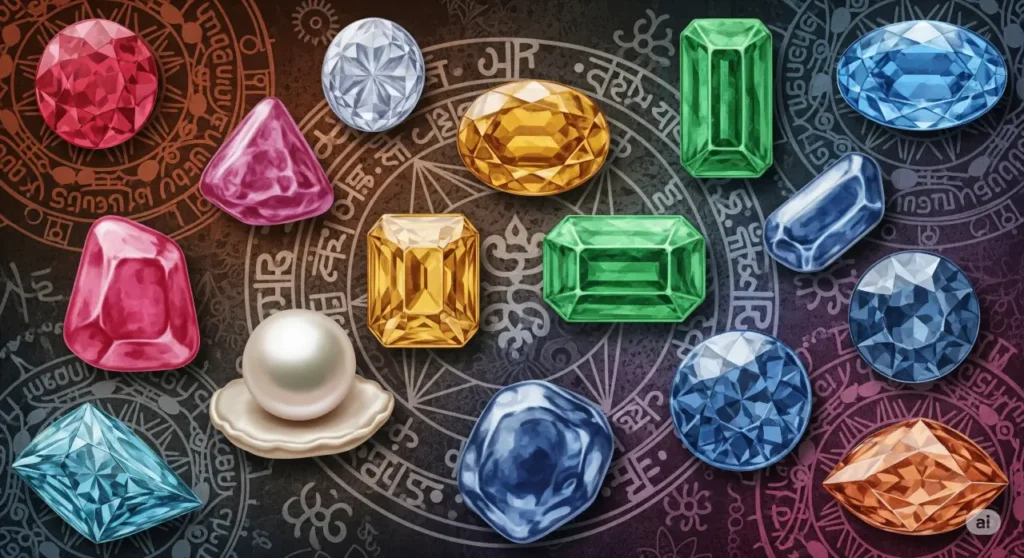
In Vedic astrology, the Navagraha (nine planets) include seven physical planets and two shadow planets (Rahu and Ketu). Each is associated with a specific gemstone:
| Planet | Sanskrit Name | Gemstone | Color | Day |
|---|---|---|---|---|
| Sun | Surya | Ruby | Red | Sunday |
| Moon | Chandra | Pearl | White | Monday |
| Mars | Mangala | Red Coral | Red | Tuesday |
| Mercury | Budha | Emerald | Green | Wednesday |
| Jupiter | Guru/Brihaspati | Yellow Sapphire | Yellow | Thursday |
| Venus | Shukra | Diamond | White | Friday |
| Saturn | Shani | Blue Sapphire | Blue | Saturday |
| Rahu | — | Hessonite Garnet | Honey-brown | Saturday |
| Ketu | — | Cat’s Eye | Grayish green | Tuesday |
Each gemstone is believed to act as a conductor for the planetary energy, amplifying the planet’s influence in the wearer’s life.
How Gemstones Work in Vedic Astrology
The underlying principle behind gemstone therapy is vibrational resonance. Each gemstone is thought to absorb and transmit cosmic rays or planetary vibrations corresponding to its associated planet. When worn correctly, the stone resonates with the planetary energy in the person’s body and aura, enhancing specific qualities like confidence (Sun), intuition (Moon), intelligence (Mercury), or discipline (Saturn).
Strengthening vs. Pacifying
In most Vedic practices, gemstones are used to strengthen benefic or weak planets, not to pacify harmful ones. For instance, if Jupiter is a benefic planet in the chart but placed in a weak or debilitated sign, wearing a yellow sapphire may help bolster Jupiter’s influence.
Some astrologers advise not to wear gemstones for malefic planets. For example, wearing blue sapphire for Saturn can be disastrous if Saturn is ill-disposed in the chart. However, in special situations (such as Saturn being a yoga-karaka), it can be highly beneficial. Hence, a precise astrological reading is imperative before wearing any gemstone.
Selection Criteria: More Than Just the Birthstone
Unlike Western birthstone traditions, Vedic gemstone recommendations are highly personalized. They depend on various factors in a person’s natal chart:
- Lagna (Ascendant) – Determines the overall planetary lordship and which planets are beneficial.
- Dasha (planetary periods) – The current operating planetary periods (Mahadasha and Antardasha) influence which planet’s energy needs enhancement.
- Planetary Strength – A gemstone can help a planet that is weak by sign, house placement, or combustion.
- Aspects and Conjunctions – Whether the planet is afflicted by enemies or helped by friends.
- Purpose of Wearing – For health, career, marriage, or spiritual reasons.
Purity and Quality of Gemstones
In Jyotish, the quality and authenticity of the gemstone are paramount. The stone should be natural (not synthetic), untreated, and free from internal flaws or inclusions. According to ancient texts, flawed gemstones can cause harm rather than healing.
Criteria include:
- Carat Weight: Should generally be at least 1 carat per 10–12 kg of body weight.
- Transparency: Should be clean and luminous, without cracks or milky patches.
- Color: Should be vivid and pure.
- Origin: Certain mines are considered more potent, such as Burmese rubies or Sri Lankan sapphires.
Imitations or chemically treated stones may lack the necessary vibrational frequency and are not considered effective.
Proper Wearing Procedures
The procedure for wearing a gemstone involves ritual and astrological precision. Key aspects include:
1. Metal Choice
Each stone is best set in a specific metal:
- Ruby – Gold
- Pearl – Silver
- Coral – Gold or Copper
- Emerald – Gold
- Yellow Sapphire – Gold
- Diamond – Platinum or Gold
- Blue Sapphire – Iron or Silver
- Hessonite – Panchdhatu or Silver
- Cat’s Eye – Panchdhatu or Silver
2. Correct Finger
Each planet is associated with a specific finger:
- Sun (Ruby) – Ring finger (right hand)
- Moon (Pearl) – Little finger
- Mars (Coral) – Ring finger
- Mercury (Emerald) – Little finger
- Jupiter (Yellow Sapphire) – Index finger
- Venus (Diamond) – Middle finger
- Saturn (Blue Sapphire) – Middle finger
- Rahu (Hessonite) – Middle finger
- Ketu (Cat’s Eye) – Ring finger
3. Muhurta (Auspicious Time)
The stone should be worn on the correct day and during the right planetary hour (Hora). A Vedic astrologer may also prescribe a particular tithi (lunar day) or nakshatra (star) for maximum benefit.
4. Energization (Pran Pratishtha)
Before wearing, the gemstone is purified with water, milk, and Ganga jal, and energized through a mantra specific to the planet. For instance, the mantra for the Sun is: Om Hram Hreem Hroum Sah Suryaya Namah. This is recited 108 times before wearing the stone.
Gemstone Combinations: What to Avoid
Some gemstones should not be worn together due to planetary enmity. For instance:
- Ruby (Sun) and Blue Sapphire (Saturn) – Enemies
- Pearl (Moon) and Hessonite (Rahu) – Incompatible
- Diamond (Venus) and Coral (Mars) – Inimical planets
Wearing conflicting stones can intensify karmic challenges rather than resolve them. Therefore, always consult a qualified astrologer before combining stones.
Temporary vs. Lifelong Gemstones
Some gemstones may be worn temporarily, during a specific Mahadasha or for a targeted life event (like marriage or exams), while others may be suited for lifelong use if the corresponding planet is a key benefic in the chart.
For example:
- A student going through Mercury Mahadasha might wear emerald for better intellect and communication.
- A person in Saturn’s Sade Sati period might be advised to wear blue sapphire—but only after testing.
The Trial Period: Testing Gemstones
Because gemstones can be powerful, some astrologers advise testing a gemstone before long-term use. This involves keeping the stone near the body (in a pouch or under a pillow) for 3–5 days. Negative symptoms—bad dreams, fatigue, accidents—may indicate that the gemstone is unsuitable.
Controversies and Scientific Skepticism
Gemstone therapy in astrology is not without its critics. From a scientific perspective, the concept that stones emit planetary vibrations lacks empirical support. Skeptics argue that any perceived benefit may be due to the placebo effect, where belief in the stone’s power creates a positive psychological outcome.
However, many astrologers and spiritual practitioners counter that subtle energies are difficult to measure with current scientific tools. Just as acupuncture and homeopathy were once dismissed and later partially accepted, they believe gemstone therapy may similarly be validated as research into quantum fields and energy medicine advances.
Gemstones and Spiritual Evolution
In addition to material success, gemstones are also used to support spiritual growth. For example:
- Yellow Sapphire (Jupiter) – Enhances wisdom and guru connection
- Blue Sapphire (Saturn) – Supports discipline and detachment
- Cat’s Eye (Ketu) – Aids in meditation and moksha (liberation)
Advanced spiritual seekers may wear specific stones to enhance their sadhana (spiritual practice), though this is typically done under a guru’s guidance.
Modern Trends: Gemstone Jewelry and Commercialization
With the rise of the wellness industry, gemstone use has become trendy, often divorced from Vedic principles. People wear stones based on fashion or Western zodiac signs, which may yield mixed or harmful results if not matched with their Vedic chart.
Online gemstone vendors have also flooded the market with synthetic or low-quality stones labeled as “astrological,” leading to mistrust and diluted efficacy. This underscores the importance of working with reputable gem dealers and knowledgeable astrologers.
Conclusion
Gemstones, when correctly chosen and worn under proper guidance, can serve as powerful tools for planetary remediation in Vedic astrology. They offer a unique intersection of matter and spirit, allowing humans to align more harmoniously with cosmic energies and fulfill their karmic journey.
However, they are not magical panaceas. Gemstones should be part of a holistic spiritual lifestyle, including right conduct (dharma), devotion (bhakti), discipline (tapas), and service (seva). Only then can their true potential be realized—not just for material gain, but for inner transformation and liberation.