Ashtang Yog: The Eightfold Path to Self-Realization

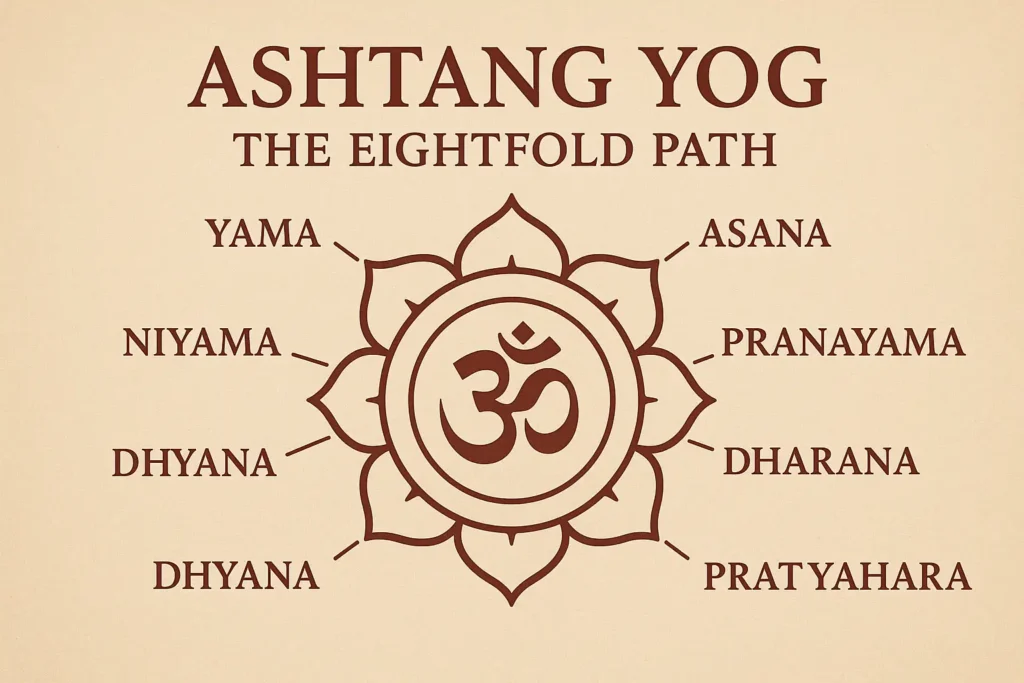
Ashtang Yog, or the “Eightfold Path of Yoga,” is one of the most profound and structured spiritual systems described in the Yoga Sutras of Maharshi Patanjali. Unlike what many today associate yoga with—mainly physical postures or exercise—Ashtang Yog is a complete philosophy of life. It’s a path designed to purify the body, mind, and soul, helping an individual rise from ordinary existence toward ultimate liberation (Moksha).
The Sanskrit term “Ashtang” means “eight limbs” (Ashta = eight, Anga = limbs). Each limb of Ashtang Yog represents a specific stage of spiritual evolution, guiding a seeker from ethical living to meditation and finally to union with the Supreme Consciousness.
Let’s explore each of these eight limbs of Astang Yoga in depth, understanding not just their theory but also their relevance in our modern lives.
1. Yama – The Ethical Foundation
Yama forms the moral and ethical base of Ashtang Yog. It deals with how we interact with the external world and other beings. Patanjali lists five Yamas that serve as universal codes of conduct:
1.1 Ahimsa (Non-violence)
Ahimsa means non-violence in thought, word, and action. It is not just about refraining from physical harm, but also about cultivating compassion and empathy. In a broader sense, Ahimsa means being mindful of how our actions affect others and nature.
Modern relevance: Practicing Ahimsa today can mean being kind in speech, avoiding hatred on social media, or choosing sustainable living to avoid harming the planet.
1.2 Satya (Truthfulness)
Satya means being truthful—not just in words, but in intention and action. It encourages us to live authentically and align our thoughts, speech, and behavior with truth.
Modern relevance: In a world filled with pretense and misinformation, Satya is about integrity and honesty, even when the truth is uncomfortable.
1.3 Asteya (Non-stealing)
Asteya means refraining from taking what is not ours, whether material possessions, ideas, or even someone’s time or energy. It encourages contentment and fairness.
Modern relevance: Respecting intellectual property, being punctual, or avoiding plagiarism are modern expressions of Asteya.
1.4 Brahmacharya (Moderation or Celibacy)
Traditionally, Brahmacharya was understood as celibacy, especially for monks. However, in a broader sense, it means control over one’s desires and use of energy wisely—especially sexual and sensory energy.
Modern relevance: It’s about self-control and channeling energy into creative and spiritual pursuits instead of indulgence and distraction.
1.5 Aparigraha (Non-possessiveness)
Aparigraha means letting go of greed and the constant desire for more. It’s the practice of detachment and simplicity.
Modern relevance: Living minimally, being satisfied with what we have, and not defining ourselves by possessions are ways to practice Aparigraha.
Together, these five Yamas purify our relationship with the outer world, creating harmony in society and peace within ourselves.
2. Niyama – The Inner Discipline
If Yama governs our relationship with others, Niyama focuses on our relationship with ourselves. It’s about personal discipline, self-care, and spiritual development. The five Niyamas are:
2.1 Shaucha (Purity)
Shaucha means cleanliness—both physical and mental. Cleanliness of body, environment, and thoughts prepares the mind for higher states of consciousness.
Practice: Keeping surroundings neat, eating pure (sattvic) food, and cultivating positive thoughts.
2.2 Santosha (Contentment)
Santosha means being content with what we have. It’s about inner peace, regardless of external circumstances.
Practice: Practicing gratitude, letting go of comparison, and finding joy in simplicity.
2.3 Tapas (Self-discipline)
Tapas literally means “to burn.” It refers to the fire of determination and austerity that burns impurities and strengthens willpower.
Practice: Regular meditation, waking up early, fasting occasionally, or maintaining discipline in habits.
2.4 Svadhyaya (Self-study)
Svadhyaya means study of the self and sacred texts. It involves reflection and understanding of our nature through introspection and spiritual learning.
Practice: Reading scriptures like the Bhagavad Gita or Yoga Sutras and observing one’s thoughts and actions mindfully.
2.5 Ishvara Pranidhana (Surrender to the Divine)
This is the act of surrendering ego and dedicating all actions to God or the Supreme Consciousness. It brings humility and peace, knowing that we are instruments of the Divine will.
Practice: Prayer, mantra chanting, or simply trusting the process of life with faith.
Together, the Yamas and Niyamas create the ethical and spiritual groundwork necessary for higher yogic practices.
3. Asana – The Physical Posture
Asana is the third limb, and it’s the most recognized aspect of yoga in the modern world. In Patanjali’s context, however, Asana isn’t about flexibility or physical fitness—it’s about finding a steady and comfortable posture (Sthira Sukham Asanam) for meditation.
Through physical postures, the body becomes strong, balanced, and healthy, allowing energy to flow freely. It also helps in mastering the body so the mind can be steadied.
Modern application: Practicing yoga postures not for display or competition, but for health, stability, and preparation for meditation. It aligns the physical with the spiritual.
4. Pranayama – Mastery of Breath
Pranayama is the control and expansion of Prana, the vital life force that sustains all living beings. “Prana” means life energy, and “Ayama” means expansion or regulation. Through conscious breathing techniques, we can regulate our energy and influence our mental state.
Purpose:
- Balances the nervous system
- Purifies energy channels (Nadis)
- Prepares the mind for meditation
Techniques:
Common pranayamas include Anulom Vilom (alternate nostril breathing), Bhastrika (bellows breath), and Kapalabhati (cleansing breath).
Modern relevance: In our fast-paced lives, conscious breathing can reduce anxiety, improve focus, and enhance overall well-being.
5. Pratyahara – Withdrawal of the Senses
Pratyahara is the bridge between the external and internal aspects of yoga. It means withdrawing the senses from external distractions and turning awareness inward.
In daily life, our senses constantly pull us outward—toward screens, noise, and stimulation. Pratyahara teaches us to take a step back, to observe without reacting.
Practice:
- Sitting quietly and observing the breath.
- Avoiding sensory overload.
- Practicing digital detox.
Benefit:
It cultivates detachment, inner peace, and mental clarity. When the senses are under control, the mind becomes calm and focused.
6. Dharana – Concentration
Once the senses are withdrawn, the next step is to focus the mind on a single point or object. This is Dharana—steady concentration.
The mind is naturally restless, constantly jumping from one thought to another. Dharana trains it to hold attention on one thing—like a mantra, a deity, the breath, or the heart center.
Practice examples:
- Focusing on the flame of a lamp (Trataka).
- Repeating a mantra with full attention.
- Visualizing a divine form or symbol.
Benefit:
Improves focus, reduces distractions, and lays the foundation for meditation.
7. Dhyana – Meditation
When concentration deepens and becomes effortless, it turns into Dhyana—meditation. Here, the flow of awareness becomes continuous, without interruption. The meditator, the act of meditation, and the object of meditation begin to merge.
Experience:
In Dhyana, one experiences deep stillness, clarity, and bliss. The mind transcends thoughts and dualities.
Modern relevance:
Even in a busy life, daily meditation can help in emotional balance, creativity, and intuitive understanding. Meditation is not escape—it’s awareness at its highest.
8. Samadhi – Union with the Divine
The final limb, Samadhi, is the ultimate goal of Ashtang Yog. It’s a state of total absorption, where the individual self (Jivatma) merges with the universal consciousness (Paramatma). In this state, there is no sense of “I” or “mine.” The meditator becomes one with the object of meditation.
Types of Samadhi (as described by Patanjali):
- Savikalpa Samadhi – The meditator is aware of the distinction between self and object, but experiences profound peace.
- Nirvikalpa Samadhi – The highest state, where all dualities dissolve, and pure consciousness alone remains.
Experience:
It is the realization of the eternal truth—Sat Chit Ananda (Existence, Consciousness, Bliss). This is liberation, or Kaivalya, the ultimate freedom from all bondage.
The Philosophy Behind Ashtang Yog
The beauty of Ashtang Yog lies in its holistic design. It addresses every aspect of human existence—ethical, physical, emotional, and spiritual. It’s not a religion but a universal science of self-evolution.
Patanjali’s framework can be seen as a step-by-step ladder:
- Yama and Niyama build moral strength.
- Asana and Pranayama balance body and energy.
- Pratyahara and Dharana stabilize the mind.
- Dhyana and Samadhi take one beyond the mind.
This systematic progression ensures that the seeker purifies themselves layer by layer, eventually realizing their true divine nature.
Ashtang Yog in Modern Life
In today’s world of constant stress, distraction, and materialism, Ashtang Yog offers a timeless solution. It teaches balance—not withdrawal from the world, but right engagement with it.
Here’s how each limb can be lived daily:
- Yama: Practice kindness, honesty, and moderation.
- Niyama: Keep routines, meditate, and maintain self-discipline.
- Asana: Do physical yoga to stay healthy.
- Pranayama: Take conscious breathing breaks during work.
- Pratyahara: Spend time in silence away from screens.
- Dharana: Do focused work without multitasking.
- Dhyana: Meditate daily to reset the mind.
- Samadhi: Strive for inner peace and connection with the higher self.
By integrating these principles, one can transform daily life into a spiritual practice.
Ashtang Yog vs Modern Yoga
Modern yoga often focuses on Asana alone—the physical aspect—while neglecting the deeper limbs. Ashtang Yog reminds us that physical postures are only a preparatory step, not the end goal.
Key difference:
- Modern yoga: Fitness, flexibility, and relaxation.
- Ashtang Yog: Self-realization, ethical living, and liberation.
However, both can coexist. Physical yoga can serve as an entry point to deeper practice if approached with awareness and sincerity.
The Role of the Guru in Ashtang Yog
In Vedic tradition, the guidance of a Guru is essential. A Guru doesn’t just teach techniques but helps remove inner obstacles. Patanjali himself emphasizes Ishvara Pranidhana—surrendering to the Divine or to a realized teacher.
The Guru acts like a mirror, reflecting the seeker’s true self and leading them from ignorance to wisdom. Without proper guidance, one can get stuck in ego or misinterpret the path.
Conclusion
Ashtang Yog is not merely a spiritual theory—it’s a living, breathing system for total transformation. It begins with simple ethical conduct and ends in divine realization. It’s practical, universal, and timeless.
In a world that often seeks happiness outside, Ashtang Yog turns our gaze inward. It reminds us that the peace we seek is already within us—hidden beneath the layers of restlessness, desire, and illusion.
By walking this Eightfold Path sincerely, step by step, one can rediscover the essence of being—pure consciousness, boundless love, and eternal peace.