
Dharma, Karma, and Moksha: The Spiritual Pillars of Hindu Life

Hinduism, one of the world’s oldest living traditions, offers a profound framework for understanding life, ethics, and the ultimate purpose of human existence. At the heart of this framework are three interconnected principles: Dharma, Karma, and Moksha. These are not abstract religious ideas but practical, lived realities that shape how a person acts, grows, and ultimately finds liberation.
For thousands of years, these concepts have guided millions toward a life of meaning, responsibility, and spiritual awakening. Understanding them is essential for anyone who wishes to grasp the essence of Hindu philosophy.
In Vedic astrology, Dharma, Karma, and Moksha are not just philosophical ideas—they are deeply connected to the four Purusharthas (life goals) reflected in a birth chart. Specific houses and planetary combinations reveal how a person fulfills their Dharma (duties), experiences the results of Karma (actions), and moves toward Moksha (spiritual liberation). For example, the 1st, 5th, and 9th houses are linked to Dharma; the 3rd, 6th, and 10th to Karma; and the 4th, 8th, and 12th to Moksha, showing how destiny and free will work together in the soul’s journey.
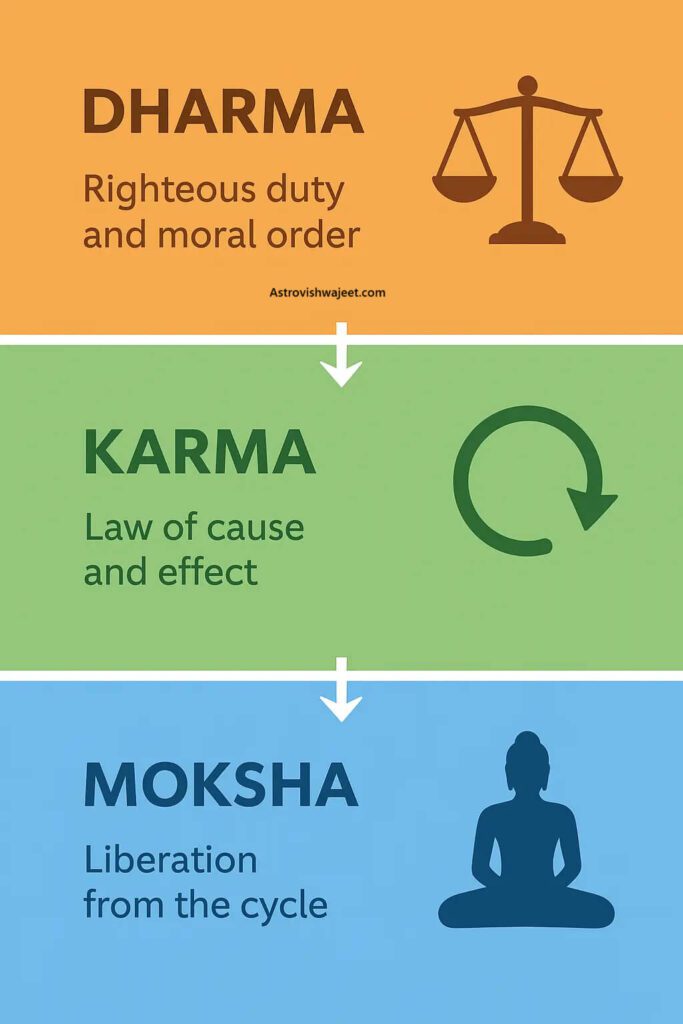
1. Introduction to the Three Pillars
1.1 Dharma: Righteous Duty and Moral Order
The Sanskrit term Dharma comes from the root word dhri, meaning “to uphold” or “to sustain.” In Hinduism, it refers to the moral and spiritual laws that sustain life and maintain harmony in the universe. Dharma is about living in alignment with truth, fairness, and cosmic order (Rta).
What makes Dharma unique is that it is dynamic—it adapts according to an individual’s role, stage in life, and circumstances.
1.2 Karma: The Law of Cause and Effect
Karma literally means “action” in Sanskrit, but in spiritual philosophy, it refers to the law that every action has consequences. This is not a system of divine reward and punishment, but a natural law of moral causation. Good deeds, born of right intention, lead to harmony and happiness; harmful actions create suffering.
Karma operates across lifetimes, influencing both present circumstances and future births.
1.3 Moksha: The Final Liberation
Moksha is the ultimate spiritual goal—freedom from the cycle of birth, death, and rebirth (Samsara). It is the realization of the true Self (Atman) and its unity with the Absolute Reality (Brahman). Moksha brings an end to ignorance (Avidya) and dissolves the illusions of separateness.
2. Scriptural Foundations
The concepts of Dharma, Karma, and Moksha are deeply embedded in Hindu sacred literature:
- The Vedas: Stress the importance of Rta (cosmic order) and duties through rituals and moral living.
- The Upanishads: Focus on self-knowledge as the path to liberation.
- The Bhagavad Gita: Explains how performing one’s duty without attachment (Karma Yoga) can lead to Moksha.
- The Dharmashastras: Provide guidelines for ethical conduct and social responsibilities.
- The Puranas: Use stories of gods, sages, and kings to illustrate how Dharma and Karma operate in real life.
3. Dharma: The Foundation of Life
3.1 The Nature of Dharma
Dharma is not merely a set of commandments; it is a living principle. What is right for one person may not be right for another, depending on their role, capabilities, and context.
For example:
- A soldier’s Dharma may require courage in battle.
- A healer’s Dharma is to preserve life.
- A spiritual teacher’s Dharma is to guide others toward truth.
3.2 Types of Dharma
Hindu thought classifies Dharma into several forms:
- Sanatana Dharma: The eternal, universal duties—truth, non-violence, compassion, purity.
- Varnashrama Dharma: Duties based on one’s social class (Varna) and stage of life (Ashrama).
- Svadharma: One’s personal duty, rooted in individual nature and circumstances.
- Yuga Dharma: Duties suited to the current age or era.
3.3 Dharma in the Bhagavad Gita
The Gita teaches that following one’s own Dharma, even imperfectly, is better than imitating someone else’s perfectly:
“It is better to fail in your own duty than to succeed in the duty of another.” (Bhagavad Gita 3.35)
4. Karma: The Invisible Architect of Destiny
4.1 How Karma Works
Karma operates like a seed: every action plants a seed in the field of life. Sooner or later, those seeds bear fruit—pleasant, unpleasant, or mixed. This law ensures moral accountability without the need for external enforcement.
4.2 Types of Karma
- Sanchita Karma: The accumulated karma from all past lives.
- Prarabdha Karma: The portion of karma currently active and shaping this lifetime.
- Agami Karma: The karma being created now that will influence the future.
4.3 The Role of Free Will
While Prarabdha Karma is fixed for the current life, we have the power to create Agami Karma through conscious action. This means we are neither entirely bound by fate nor entirely free; life is a blend of past influences and present choices.
5. Moksha: Freedom from the Cycle
5.1 The Nature of Liberation
Moksha is the end of the endless cycle of Samsara. It is not annihilation but the realization that the soul was never bound in the first place. When ignorance is removed, the Atman is seen as pure, infinite, and one with Brahman.
5.2 Paths to Moksha
Hinduism offers multiple paths:
- Jnana Yoga: The path of wisdom and self-inquiry.
- Bhakti Yoga: The path of love and devotion.
- Karma Yoga: The path of selfless service.
- Raja Yoga: The path of meditation and discipline.
Each path caters to different temperaments, yet they all converge in the same truth.
6. Interconnection of Dharma, Karma, and Moksha
These principles are deeply intertwined:
- Dharma ensures actions are aligned with moral order.
- Karma ensures those actions have consequences, refining the soul.
- Moksha is attained when actions are pure and the mind is free from ego.
Example: A farmer fulfills his Dharma by working honestly, accepts the fruits of labor without greed (good Karma), and over time cultivates detachment, leading toward Moksha.
7. Living by These Principles Today
7.1 Practicing Dharma
- Speak truthfully and act with integrity.
- Perform duties to family, society, and self.
- Adapt responsibilities to current circumstances without abandoning moral values.
7.2 Creating Positive Karma
- Avoid harmful actions in thought, word, and deed.
- Act with kindness, generosity, and patience.
- Serve without expectation of reward.
7.3 Moving Toward Moksha
- Dedicate time for spiritual study and meditation.
- Cultivate detachment from material possessions.
- Focus on self-realization as life’s highest purpose.
8. Misconceptions
- Dharma is not blind obedience: It is discernment-based living.
- Karma is not fatalism: It empowers personal responsibility.
- Moksha is not escapism: It is the highest state of fulfillment.
9. Modern Relevance
In today’s fast-paced and morally complex world, these concepts are more relevant than ever:
- Dharma offers ethical clarity amidst confusion.
- Karma reinforces accountability for one’s actions.
- Moksha reminds us that ultimate peace lies within, not in material gain.
10. Conclusion
Dharma, Karma, and Moksha together form a complete philosophy of life. Dharma gives us the moral compass, Karma teaches that every action matters, and Moksha reminds us of our ultimate spiritual destiny.
By living in accordance with these principles, we not only create a harmonious life for ourselves but also contribute to a more balanced and compassionate world.