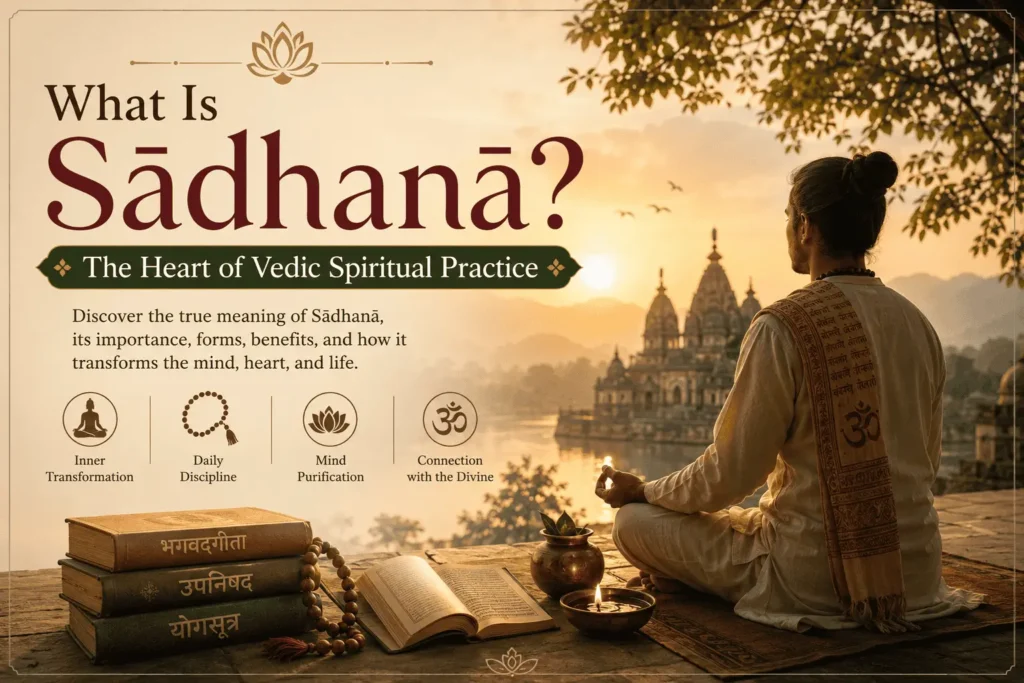
What Is Sadhana? The Heart of Vedic Spiritual Practice

In the ancient spiritual traditions of India, the word Sadhana carries a profound meaning. It refers to a disciplined spiritual practice undertaken with the intention of achieving inner growth, self-realization, and ultimately a deeper connection with the Divine. While Sadhana may include practices such as meditation, mantra chanting, prayer, yoga, worship, or scriptural study, it is much more than simply following a set of religious rituals.
The Sanskrit word Sādhanā comes from the root sādh, which means “to accomplish,” “to attain,” “to bring about,” or “to reach a goal.” A person who practices Sādhanā is therefore consciously working toward a spiritual goal. The goal may differ from one individual to another. For some, it may be peace of mind and devotion to God. For others, it may be liberation (mokṣa), self-knowledge, or realization of the true nature of the Self.
In the Vedic and Hindu spiritual traditions, Sādhanā is considered a practical path rather than merely an intellectual understanding of spirituality. Reading scriptures can provide knowledge, and listening to a spiritual teacher can provide guidance, but Sādhanā transforms spiritual knowledge into lived experience.
At its heart, Sādhanā is the process of transforming the individual from within.
The Meaning of Sādhanā in Vedic Tradition
The concept of Sādhanā is deeply connected with the broader Vedic understanding of human life. According to many Hindu philosophical traditions, the purpose of life is not limited to material success, wealth, social status, or sensory enjoyment. Human beings have the capacity to discover a deeper reality beyond the temporary experiences of the body and mind.
Sādhanā provides a disciplined method for pursuing that discovery.
A spiritual practitioner, traditionally known as a sādhaka, undertakes practices that gradually purify the mind, regulate the senses, develop concentration, cultivate devotion, and deepen awareness. The process is not necessarily about escaping ordinary life. Instead, it is about changing one’s relationship with life.
A person may continue working, raising a family, studying, or fulfilling social responsibilities while practicing Sādhanā. What changes is the inner attitude with which those activities are performed.
The Bhagavad Gītā presents this principle through teachings on Karma Yoga, Bhakti Yoga, Jñāna Yoga, and meditation. Spiritual practice can therefore take different forms depending on an individual’s temperament, circumstances, and spiritual aspiration.
Why Is Sādhanā Important?
The human mind is naturally restless. It constantly moves between memories, desires, fears, plans, emotions, and sensory impressions. Without discipline, the mind can easily become scattered.
Sādhanā creates a structure through which the practitioner gradually develops control and awareness.
Regular spiritual practice can help cultivate qualities such as concentration, patience, self-discipline, compassion, humility, devotion, and inner stability. These qualities are not developed overnight. They emerge through consistent effort.
One of the most important principles of Sādhanā is therefore regularity.
Practicing for a few minutes every day can be more meaningful than practicing intensely once in a while. The purpose is to establish a spiritual rhythm in daily life.
Just as physical exercise gradually strengthens the body, spiritual practice gradually trains the mind and character.
Sādhanā and the Discipline of the Mind
The mind plays a central role in Vedic spirituality. The Upaniṣadic and yogic traditions repeatedly emphasize the importance of understanding and mastering the mind.
An uncontrolled mind can become a source of confusion and suffering. A disciplined mind, on the other hand, can become an instrument for knowledge and spiritual realization.
Sādhanā provides practical methods for working with the mind.
During meditation, for example, the practitioner may notice how frequently thoughts arise. Instead of becoming frustrated, the practitioner learns to observe thoughts without immediately identifying with them.
Similarly, during mantra practice, the mind may wander repeatedly. Each time the practitioner gently returns attention to the mantra, concentration becomes stronger.
This process may appear simple, but it represents an important spiritual training. The practitioner gradually learns that thoughts and emotions can be observed rather than automatically obeyed.
Over time, this creates greater inner freedom.
Different Forms of Sādhanā
Sādhanā does not have only one form. Hindu and Vedic traditions contain numerous spiritual disciplines, allowing practitioners to follow different approaches according to their nature and spiritual goals.
Some of the most common forms include meditation, mantra Sādhanā, devotional worship, yoga, selfless service, scriptural study, pilgrimage, austerity, and contemplative practices.
Different paths may appear separate, but they often share the same fundamental purpose: purification and transformation of consciousness.
A person may practice one primary discipline or combine several practices under appropriate guidance.
Mantra Sādhanā
Mantra Sādhanā is one of the most widely known forms of spiritual practice in Hindu traditions.
A mantra is a sacred sound, syllable, word, or phrase traditionally transmitted through a spiritual lineage. Mantras may be associated with particular deities, philosophical principles, or aspects of Divine consciousness.
Examples include Oṁ, the Gāyatrī Mantra, and various mantras dedicated to Shiva, Vishnu, Devī, Ganesha, and other forms of the Divine.
Mantra practice may involve repeating the mantra aloud, softly, or mentally. Repetition is often performed using a japa mālā, traditionally consisting of 108 beads.
The purpose of mantra Sādhanā is not simply to repeat words mechanically. With disciplined practice, the sound becomes an object of concentration and devotion.
The practitioner gradually moves from external repetition toward deeper mental absorption.
In traditional settings, certain mantras are received from a qualified Guru through dīkṣā, or initiation. This reflects the importance of lineage and proper guidance in many forms of mantra Sādhanā.
Meditation as Sādhanā
Meditation is another important form of Sādhanā.
In yogic traditions, meditation involves progressively developing concentration and awareness. The practitioner may focus on the breath, a mantra, an image of a deity, a spiritual concept, or awareness itself, depending on the method.
The goal is not necessarily to eliminate every thought. Instead, meditation develops the ability to remain aware without being constantly carried away by mental activity.
Regular meditation can gradually create a greater sense of inner stillness.
In the Yoga Sūtras of Patañjali, meditation forms part of the larger eight-limbed path of Aṣṭāṅga Yoga. The progression includes ethical disciplines, personal observances, posture, breath regulation, withdrawal of the senses, concentration, meditation, and ultimately samādhi.
This illustrates an important point: traditional spiritual practice is often understood as a complete transformation of one’s life rather than a technique practiced in isolation.
Bhakti as Sādhanā
For many practitioners, Sādhanā takes the form of Bhakti, or devotion.
Bhakti Sādhanā involves cultivating a loving relationship with the Divine. Prayer, devotional singing, worship, remembrance of God’s name, reading sacred stories, temple worship, and surrender are common expressions of this path.
The Bhakti tradition recognizes that spiritual realization does not have to be approached only through intellectual inquiry or meditation. Love itself can become a spiritual path.
A devotee may see the Divine as a beloved, parent, child, friend, master, or chosen deity.
The external form of worship may differ, but the inner purpose is to develop remembrance of the Divine and gradually reduce excessive attachment to the ego.
Karma Yoga as Sādhanā
Sādhanā does not require a person to withdraw from everyday responsibilities.
The Bhagavad Gītā presents Karma Yoga, the path of selfless action, as a powerful spiritual discipline. According to this approach, ordinary actions can become Sādhanā when performed without excessive attachment to personal reward.
For example, serving one’s family, performing one’s professional responsibilities honestly, helping others, or contributing to society can become spiritual practices when performed with the right attitude.
The essential transformation occurs internally.
Instead of thinking, “I am doing this only for myself,” the practitioner gradually develops an attitude of offering.
This is closely related to the concept of īśvara-praṇidhāna, surrender or dedication to the Divine.
Jñāna and the Practice of Self-Inquiry
Another profound form of Sādhanā is Jñāna Sādhanā, the pursuit of spiritual knowledge.
In Advaita Vedānta and other philosophical traditions, the practitioner investigates fundamental questions such as:
“Who am I?”
“What is the nature of the Self?”
“What is permanent and what is temporary?”
“What is the relationship between the individual self and ultimate reality?”
Self-inquiry is not merely an intellectual exercise. The purpose is to examine deeply held assumptions about identity and existence.
Through study, contemplation, discrimination, and guidance from traditional teachings, the practitioner seeks to recognize the difference between the temporary personality and the deeper Self.
This path requires sincerity, discrimination, patience, and a mind prepared for contemplation.
The Role of a Guru in Sādhanā
The Guru has traditionally held an important place in many Indian spiritual traditions.
The Sanskrit term Guru is often interpreted as a spiritual teacher who guides a disciple from ignorance toward knowledge. A qualified teacher can help the practitioner understand the appropriate method, correct misunderstandings, and maintain direction on the spiritual path.
Not every spiritual practice requires formal initiation or a Guru in the same way. However, traditional disciplines, particularly certain forms of mantra, Tantra, and advanced yogic practice, are often undertaken under direct guidance.
The relationship between Guru and disciple is traditionally based on trust, discipline, humility, and sincere commitment to spiritual growth.
At the same time, genuine spiritual guidance should encourage discrimination and understanding rather than blind dependence.
Sādhanā and the Importance of a Daily Routine
One of the simplest ways to begin Sādhanā is to establish a consistent daily routine.
A practitioner may begin the day with prayer, meditation, mantra repetition, or reading a few verses from a sacred text. Even 10 or 15 minutes of sincere practice can become meaningful when maintained consistently.
A traditional routine might include waking early, bathing, sitting in a clean and quiet place, performing prayer or worship, practicing Prāṇāyāma or meditation, and concluding with a period of silent reflection.
However, Sādhanā does not have to become unnecessarily complicated.
The most important qualities are sincerity, regularity, discipline, and awareness.
A simple practice performed with complete attention is often more valuable than a complicated ritual performed mechanically.
The Role of Brahma Muhūrta
Traditional Hindu practice often gives special importance to Brahma Muhūrta, the period before sunrise.
This time is considered particularly suitable for meditation, prayer, mantra Japa, scriptural study, and contemplation because the environment is generally quieter and the mind may be less occupied by the activities of the day.
However, spiritual practice should remain practical. A person who cannot wake before sunrise should not conclude that meaningful Sādhanā is impossible.
Consistency matters more than forcing an unsuitable schedule.
The ideal routine is one that can be followed sincerely and sustainably.
Sādhanā, Tapas, and Self-Discipline
Another important concept associated with Sādhanā is Tapas.
Tapas is often translated as austerity, discipline, or spiritual effort. It does not necessarily mean harsh physical suffering. In a broader sense, it refers to the disciplined effort required to transform oneself.
For example, choosing to meditate instead of spending excessive time distracted by entertainment can be a form of discipline.
Maintaining truthful speech, controlling unnecessary desires, observing moderation in food, and remaining committed to one’s spiritual practice are also forms of Tapas.
The purpose of discipline is not to punish the body or suppress natural life. Rather, it is to develop mastery over one’s impulses.
The Importance of Purification
In many Vedic traditions, Sādhanā is closely associated with śuddhi, or purification.
Purification can be understood at different levels.
There is physical discipline, ethical purification, emotional purification, and purification of thought.
Practices such as prayer, meditation, selfless service, truthful living, devotion, and scriptural study are traditionally understood to help reduce negative tendencies such as excessive anger, greed, jealousy, pride, attachment, and selfishness.
This does not mean that a practitioner becomes perfect immediately.
Spiritual growth involves recognizing one’s weaknesses without becoming overwhelmed by them.
The important question is not whether negative thoughts ever appear, but whether the practitioner becomes increasingly capable of observing and transforming them.
Sādhanā Is a Journey, Not a Quick Solution
One of the biggest misunderstandings about spiritual practice is the expectation of immediate results.
A person may begin meditation expecting instant peace. Another may start mantra practice expecting supernatural experiences. Someone else may begin worship hoping that every personal problem will disappear.
Traditional Sādhanā takes a different approach.
It is a long-term process of transformation.
There may be periods of enthusiasm and periods of difficulty. Sometimes meditation may feel peaceful. At other times, the mind may seem more restless than ever.
These experiences are part of the journey.
The practitioner learns patience and continues the practice without becoming obsessed with temporary experiences.
Spiritual progress cannot always be measured externally.
Sometimes the greatest signs of progress are subtle: becoming less reactive, developing greater compassion, reducing unnecessary desires, becoming more patient, and experiencing a deeper sense of contentment.
The Difference Between Sādhanā and Ritual
Ritual and Sādhanā are closely connected in many Hindu traditions, but they are not identical.
A ritual can be performed externally, while Sādhanā involves inner participation.
For example, lighting a lamp before a deity is a ritual. Performing that act with devotion, concentration, reverence, and awareness can turn it into Sādhanā.
Similarly, chanting a mantra mechanically is different from repeating it with attention and spiritual intention.
The external practice provides the structure. The inner attitude gives it depth.
This is why two people may perform the same ritual but experience it very differently.
Sādhanā in Modern Life
Sādhanā remains relevant even in today’s fast-paced world.
Modern life is filled with information, technology, constant communication, and distractions. Many people struggle to find periods of silence and uninterrupted attention.
A spiritual practice can provide an anchor.
It does not necessarily require abandoning modern life. Instead, Sādhanā can help a person live modern life with greater awareness.
A professional can practice mindfulness and ethical action at work. A parent can practice patience and selfless service at home. A student can develop concentration through meditation. Anyone can cultivate gratitude, prayer, devotion, and self-reflection.
The spiritual path can therefore exist within ordinary life.
How to Begin a Simple Sādhanā Practice
Someone who is new to Sādhanā does not need to begin with an elaborate routine.
A simple daily practice could begin with sitting quietly for 10 minutes each morning.
The practitioner may begin with a short prayer, followed by a few minutes of conscious breathing. This can be followed by mantra Japa, meditation, or reading a short passage from a respected spiritual text.
The practice can conclude with a moment of gratitude and an intention to live consciously throughout the day.
As the practice becomes established, the duration and depth can gradually increase.
The key is to avoid constantly changing methods. Choosing a suitable practice and giving it enough time allows the mind to settle into a rhythm.
For practices involving specific mantras, advanced Prāṇāyāma, Tantra, or other specialized disciplines, guidance from a competent teacher is advisable.
The Ultimate Goal of Sādhanā
The ultimate goal of Sādhanā depends on the tradition and the practitioner’s path.
For a devotee, it may be loving union with or surrender to God.
For a practitioner of Yoga, it may be liberation through the stilling of the fluctuations of the mind.
For a Vedānta practitioner, it may be realization of the true nature of the Self and freedom from ignorance.
For someone following Karma Yoga, it may be freedom from attachment to the fruits of action.
Despite these different descriptions, many traditions point toward a similar transformation: freedom from ignorance, selfish attachment, and compulsive identification with the limited ego.
Sādhanā ultimately leads the practitioner inward.
Sādhanā as a Way of Life
Sādhanā should not be understood merely as something done for a few minutes in the morning.
At a deeper level, it becomes a way of living.
The way we speak, eat, work, think, respond to difficulties, treat other people, and use our time can all become part of spiritual practice.
A person may sit in meditation for thirty minutes and then spend the rest of the day in anger and selfishness. Another person may practice meditation for a shorter period but sincerely attempt to live with compassion and awareness throughout the day.
The deeper purpose of Sādhanā is transformation.
It gradually brings spiritual awareness into ordinary actions.
Conclusion
Sādhanā is the disciplined journey from spiritual aspiration to spiritual experience. It is the practical heart of many Vedic and Hindu spiritual traditions.
Whether expressed through meditation, mantra Japa, Bhakti, Yoga, selfless service, scriptural study, self-inquiry, or worship, Sādhanā asks the practitioner to make spirituality a lived experience.
Its essence is not complexity but sincerity.
A meaningful Sādhanā practice does not necessarily require withdrawal from society or a life filled with elaborate rituals. It requires regular effort, discipline, awareness, and a genuine desire to know the deeper truth of existence.
The journey may be gradual, and there may be challenges along the way. Yet each sincere moment of prayer, meditation, selfless action, remembrance, and self-inquiry contributes to inner transformation.
In the Vedic spiritual vision, the human being is capable of moving beyond the restless surface of life and discovering a deeper reality within.
Sādhanā is the journey that makes this possibility a personal experience.
It is not simply something we practice.
It is a path through which we gradually become what we are seeking.