Karma and Destiny: The Philosophy Behind Vedic Astrology

For thousands of years, Vedic Astrology has guided people seeking meaning, direction, and spiritual understanding. Known traditionally as Jyotisha, meaning “the science of light,” Vedic astrology is far more than a predictive tool. It is a profound philosophical system rooted in the ancient wisdom of the Vedas and deeply connected with the concepts of karma, destiny, reincarnation, and spiritual evolution.
At the heart of Vedic astrology lies a timeless question: Are our lives controlled by fate, or do we possess free will? The answer offered by this ancient tradition is subtle and deeply philosophical. According to Vedic thought, human life is shaped by both destiny and conscious action. Our past karmas create the framework of our current life, but our present actions continue to shape the future.
Vedic astrology acts as a cosmic map that reveals the karmic patterns influencing an individual’s life journey. The positions of planets at the moment of birth are not considered random events. Instead, they are viewed as reflections of the soul’s accumulated karma and spiritual lessons.
Understanding the relationship between karma and destiny helps us approach life with greater awareness, responsibility, and acceptance. Rather than seeing astrology as superstition or fatalism, Vedic philosophy presents it as a sacred tool for self-knowledge and spiritual growth.
Understanding Karma in Vedic Philosophy
The Sanskrit word karma literally means “action.” However, in Vedic philosophy, karma refers not only to actions themselves but also to the consequences generated by those actions. Every thought, intention, emotion, and deed creates an energetic imprint that eventually returns to the individual.
This principle is rooted in the universal law of cause and effect. Just as every seed produces a corresponding fruit, every action produces results that manifest either immediately or in future circumstances.
In Bhagavad Gita, karma is explained as an unavoidable cosmic law governing human existence. No action disappears without consequence. Positive actions generate harmony and spiritual growth, while harmful actions create suffering and obstacles.
Vedic philosophy generally classifies karma into three main categories:
1. Sanchita Karma
This is the accumulated karma from all past lifetimes. It represents the vast storehouse of karmic impressions carried by the soul.
2. Prarabdha Karma
This portion of karma has begun to manifest in the present lifetime. It determines major life circumstances such as birth family, physical body, relationships, talents, and certain unavoidable experiences.
3. Kriyamana or Agami Karma
This refers to the karma being created through present actions. It shapes future experiences and future incarnations.
Vedic astrology primarily focuses on understanding Prarabdha Karma, the karmic blueprint active in the current life. The birth chart reveals the lessons, challenges, strengths, and opportunities chosen by the soul for spiritual evolution.
Destiny in Vedic Astrology
In modern discussions, destiny is often misunderstood as a rigid, unavoidable force. However, Vedic astrology presents a more balanced perspective.
Destiny is viewed as the unfolding of past karmic patterns. Certain life experiences become highly probable because they arise from karmic debts or merits accumulated previously. These experiences may include:
- Family background
- Health tendencies
- Financial opportunities
- Marriage patterns
- Career inclinations
- Spiritual tendencies
- Major life transformations
The birth chart, or Janma Kundali, serves as a symbolic representation of these karmic influences. The planetary positions at birth indicate the timing and nature of experiences likely to occur.
Yet Vedic astrology does not teach helpless fatalism. Instead, it suggests that destiny operates within a framework of possibilities. Human consciousness and present actions still matter greatly.
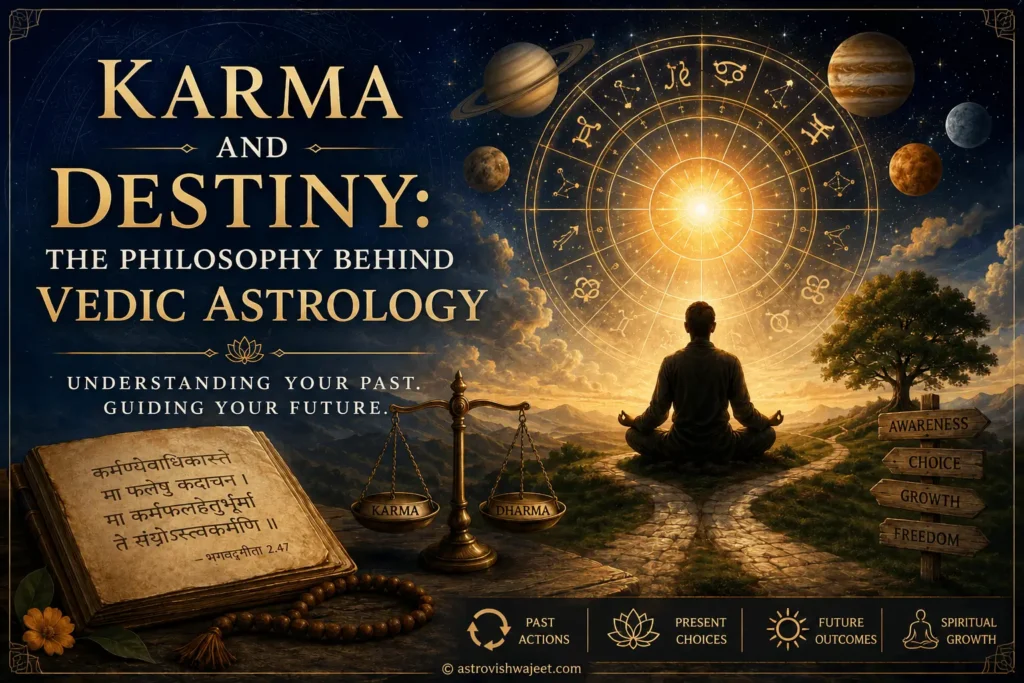
A useful analogy often used by Vedic teachers compares life to a card game. The cards dealt represent destiny or past karma, while how one plays those cards represents free will.
The Cosmic Connection Between Planets and Karma
In Vedic Astrology, planets are not viewed merely as physical celestial objects. They are seen as carriers of cosmic intelligence and karmic indicators.
Each planet symbolizes specific psychological energies and life lessons.
The Sun
The Sun represents the soul, authority, ego, vitality, and life purpose. A strong Sun often indicates leadership qualities and confidence, while a challenged Sun may reflect struggles related to identity or self-worth.
The Moon
The Moon governs emotions, mind, intuition, and mental stability. Its placement reveals emotional patterns carried from past karmas.
Saturn
Among all planets, Saturn is most strongly associated with karma. Known as the great teacher, Saturn brings discipline, delays, responsibilities, and lessons that encourage maturity and spiritual growth.
When Saturn influences an area of life, individuals often experience hardship, patience-testing situations, or karmic accountability. However, Saturn’s purpose is not punishment. Its deeper role is transformation through wisdom and endurance.
Jupiter
Jupiter symbolizes wisdom, blessings, spirituality, knowledge, and dharma. Positive Jupiter influences often indicate good karma accumulated through ethical and spiritual living.
Rahu and Ketu
The lunar nodes, Rahu and Ketu, hold immense karmic significance in Vedic astrology.
- Rahu represents desires, worldly ambitions, obsessions, and lessons the soul seeks to explore in this lifetime.
- Ketu represents past-life mastery, detachment, and spiritual liberation.
Together, they reveal the karmic axis of the soul’s evolution.
Reincarnation and the Soul’s Journey
The philosophy of karma cannot be fully understood without the concept of reincarnation.
According to Vedic thought, the soul is eternal. Physical death is not the end of existence but a transition from one life experience to another. The soul carries karmic impressions across multiple births until spiritual liberation, known as moksha, is attained.
This belief explains why individuals are born into vastly different circumstances despite having taken birth at the same time in history. Vedic philosophy sees these differences not as arbitrary injustice but as part of the soul’s karmic journey.
Astrology therefore becomes a tool for understanding the deeper purpose behind life events. Difficult experiences are not viewed merely as suffering but as opportunities for karmic resolution and spiritual awakening.
For example:
- Financial struggles may teach humility and discipline.
- Relationship challenges may encourage emotional maturity.
- Illness may inspire inner transformation or detachment.
- Success may test ethical responsibility and ego control.
Every experience contributes to the soul’s growth.
Free Will vs Fate in Vedic Astrology
One of the most fascinating aspects of Vedic astrology is its nuanced understanding of free will.
A common misconception is that astrology predicts a completely fixed future. However, classical Vedic teachings emphasize that while some karmic experiences are unavoidable, human effort still plays a major role.
The Sanskrit concept of Purushartha refers to conscious self-effort. It teaches that individuals possess the ability to make choices, develop wisdom, and transform their responses to circumstances.
For instance, two people may experience difficult Saturn periods:
- One may become bitter, fearful, and defeated.
- Another may develop resilience, patience, and spiritual strength.
The external circumstances may resemble destiny, but the internal response reflects free will.
Thus, astrology does not eliminate personal responsibility. Instead, it encourages greater awareness of karmic tendencies so individuals can make wiser decisions.
In this sense, Vedic astrology functions more like a spiritual guidance system than a rigid prediction mechanism.
The Role of Dharma
Another essential philosophical concept in Vedic astrology is Dharma.
Dharma can be translated as righteous living, sacred duty, or alignment with cosmic order. Every soul is believed to have a unique dharma based on its karmic evolution.
The birth chart helps identify this life purpose by analyzing planetary placements, houses, and signs connected with vocation, ethics, spirituality, and talents.
Living according to one’s dharma creates harmony and spiritual progress. Ignoring dharma often leads to confusion, suffering, and inner dissatisfaction.
For example:
- A person naturally gifted in teaching may feel unfulfilled pursuing purely material ambitions.
- Someone with strong spiritual inclinations may suffer emotionally in environments focused solely on competition and greed.
Vedic astrology encourages individuals to align their actions with their deeper soul nature rather than merely external success.
Karma and Relationships
Relationships hold special karmic significance in Vedic philosophy.
Family members, spouses, friends, and even rivals are often believed to share karmic connections formed over multiple lifetimes. Encounters are rarely considered accidental.
Certain relationships may involve:
- Emotional debts
- Unfinished lessons
- Mutual spiritual growth
- Past-life attachments
- Healing opportunities
The astrological chart can reveal relationship patterns, compatibility, emotional tendencies, and karmic challenges.
For instance:
- Strong Saturn influences in relationships may indicate karmic responsibilities or delayed partnerships.
- Rahu influences may create intense attraction, obsession, or unconventional connections.
- Ketu influences may produce detachment or spiritual bonds.
Understanding karmic patterns in relationships can encourage compassion and emotional maturity rather than blame.
The Importance of Timing: Dasha Systems
A unique feature of Vedic astrology is the Dasha system, which analyzes planetary periods influencing different stages of life.
The most widely used system is the Vimshottari Dasha. It divides life into planetary cycles, each activating specific karmic themes.
For example:
- A Jupiter period may bring growth, wisdom, education, or prosperity.
- A Saturn period may emphasize discipline, responsibilities, and karmic tests.
- A Venus period may focus on relationships, creativity, and material pleasures.
Dashas do not create karma independently. Instead, they activate karmic potentials already present in the birth chart.
This understanding reinforces the idea that life unfolds according to deeper spiritual timing rather than random coincidence.
Remedies in Vedic Astrology
One of the most misunderstood aspects of Vedic astrology is the use of remedies.
Critics sometimes assume remedies are attempts to magically erase destiny. Traditional Vedic philosophy, however, views remedies differently.
Astrological remedies aim to harmonize consciousness, reduce negative tendencies, and encourage positive karmic action. Common remedies include:
- Mantra chanting
- Meditation
- Charity and service
- Fasting
- Gemstone usage
- Temple worship
- Spiritual discipline
These practices are believed to purify the mind and create beneficial karmic influences.
For example, charity associated with Saturn may help cultivate humility and compassion, thereby easing certain karmic burdens.
Remedies are most effective when combined with sincere self-improvement and ethical living.
Spiritual Evolution Through Astrology
Ultimately, the highest purpose of Vedic astrology is spiritual awakening.
Material predictions regarding wealth, marriage, or career are considered secondary compared to the deeper goal of self-realization.
The birth chart serves as a mirror reflecting:
- Strengths and weaknesses
- Attachments and fears
- Talents and limitations
- Karmic patterns
- Spiritual potential
By understanding these influences, individuals can live more consciously and compassionately.
Vedic astrology teaches that suffering often arises from ignorance of our true nature. Through self-awareness and spiritual practice, the soul gradually transcends karmic bondage.
The final goal is moksha, liberation from the cycle of birth and death.
Modern Relevance of Karma and Vedic Astrology
In today’s fast-paced world, many people feel disconnected, anxious, and uncertain about their purpose. The philosophy behind Vedic astrology continues to attract interest because it offers a deeper framework for understanding human experience.
Rather than seeing life as meaningless chaos, Vedic philosophy presents existence as spiritually purposeful.
This perspective can provide:
- Emotional resilience during hardships
- Greater self-awareness
- Acceptance of life lessons
- Ethical responsibility
- Spiritual direction
- Compassion toward others
Importantly, Vedic astrology does not encourage passive resignation. Instead, it inspires conscious living.
By recognizing karmic tendencies, individuals can make better choices, cultivate wisdom, and participate actively in their spiritual evolution.
Conclusion
The relationship between karma and destiny forms the philosophical foundation of Vedic Astrology. According to this ancient wisdom tradition, life is neither entirely predetermined nor completely random. Human beings inherit karmic patterns from past actions, yet they also possess the power to shape the future through present awareness and effort.
The birth chart acts as a sacred map revealing the soul’s lessons, challenges, and opportunities for growth. Planets symbolize karmic energies guiding individuals toward maturity, wisdom, and ultimately spiritual liberation.
Far from promoting fear or fatalism, Vedic astrology encourages responsibility, self-knowledge, and alignment with dharma. It reminds us that every experience carries meaning and every action influences the unfolding journey of the soul.
In this way, karma and destiny are not opposing forces but interconnected aspects of spiritual evolution. Destiny reflects the momentum of past karma, while conscious action creates the path ahead.
Through understanding this philosophy, astrology becomes more than prediction. It becomes a profound tool for inner transformation and a bridge between cosmic order and human consciousness.