Moon and Jupiter Conjunction in Different Houses

In Vedic astrology, the Moon and Jupiter conjunction is considered an important planetary combination associated with wisdom, emotional intelligence, prosperity, generosity, and spiritual development. When the Moon and Jupiter occupy the same house in a birth chart, their combined influence is traditionally interpreted through the themes represented by that house, the zodiac sign, planetary strength, and the overall horoscope.
The Moon represents the mind, emotions, intuition, mother, mental peace, and public image. Jupiter, also known as Guru or Brihaspati, represents wisdom, knowledge, education, prosperity, children, teachers, religion, and dharma. When these two planets come together, the emotional sensitivity of the Moon combines with Jupiter’s expansive and philosophical nature.
This conjunction is commonly associated with optimism, compassion, a desire for knowledge, and the ability to guide or support others. Depending on its placement, it may influence different aspects of life, including personality, family, wealth, education, relationships, career, and spirituality.
The Moon and Jupiter conjunction is also discussed in connection with Gajakesari Yoga, one of the well-known yogas in Vedic astrology. However, the conjunction alone does not automatically guarantee a strong Gajakesari Yoga or favorable results in every birth chart. Classical conditions, planetary dignity, aspects, house ownership, and overall chart strength must also be considered.
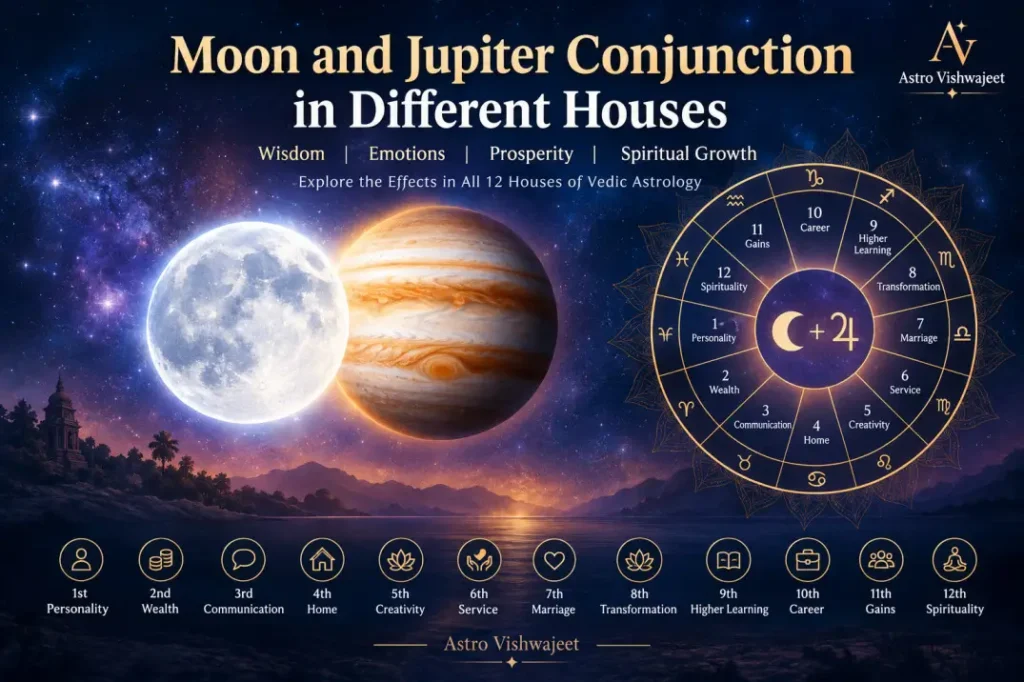
In this article, we will explore the effects of the Moon and Jupiter conjunction in all 12 houses, along with its significance, possible benefits, challenges, and important factors that influence its results.
What Does the Moon and Jupiter Conjunction Mean in Vedic Astrology?
A planetary conjunction occurs when two or more planets occupy the same zodiac sign. In a birth chart, the house containing the conjunction indicates the area of life where the combined planetary themes may become prominent.
The Moon and Jupiter conjunction is traditionally considered favorable because both planets are natural benefics in Vedic astrology. Nevertheless, their results depend on their individual strength, functional roles, and relationships with other planets.
Significance of the Moon
The Moon represents the mind, emotions, intuition, nourishment, adaptability, and the relationship with the mother. It is also associated with public perception and the ability to connect emotionally with others.
A strong Moon is traditionally linked with emotional sensitivity, imagination, receptivity, and mental adaptability. A challenged Moon may indicate fluctuating emotions or difficulty maintaining inner balance, depending on the broader horoscope.
Significance of Jupiter
Jupiter represents wisdom, higher education, children, teachers, ethics, religion, prosperity, and spiritual knowledge. It is associated with expansion, optimism, generosity, and the pursuit of meaningful goals.
A well-placed Jupiter is traditionally associated with sound judgment, learning, ethical conduct, and the ability to guide others. When challenged, its expansive qualities may manifest as overconfidence, excessive spending, or unrealistic expectations.
Combined Effects of Moon and Jupiter
When the Moon and Jupiter combine, emotional understanding may be supported by wisdom, optimism, and a broader perspective. This conjunction is traditionally associated with compassion, generosity, intellectual curiosity, and an interest in spiritual or philosophical subjects.
Depending on the birth chart, it may be relevant to professions such as teaching, counseling, writing, finance, education, administration, and public service.
However, no single conjunction determines a person’s entire life. The ascendant, planetary dignity, house ownership, aspects, divisional charts, and planetary periods all contribute to a complete interpretation.
Moon and Jupiter Conjunction in the First House
The first house, also known as the Lagna or Ascendant, represents personality, temperament, appearance, physical constitution, and the general approach to life.
When the Moon and Jupiter conjunction occurs in the first house, it may indicate a warm, generous, thoughtful, and approachable personality. These individuals may be interested in learning, philosophy, spirituality, or helping others through knowledge and experience.
Jupiter contributes optimism and wisdom, while the Moon adds emotional sensitivity and intuition. Together, they may support communication skills and the ability to understand different perspectives.
Professionally, this placement may be relevant to teaching, consulting, counseling, management, public relations, or leadership roles.
In relationships, individuals may value kindness, emotional understanding, and shared principles. However, excessive generosity, idealism, or overconfidence may sometimes create difficulties.
The final results depend on the ascendant, the sign occupied by the conjunction, and the condition of the first-house lord.
Moon and Jupiter Conjunction in the Second House
The second house governs accumulated wealth, savings, family values, speech, food habits, and traditional knowledge.
The Moon and Jupiter conjunction in the second house is traditionally associated with pleasant speech, family attachment, generosity, and an interest in financial security. Individuals may have an aptitude for communication, education, finance, writing, or advisory work.
Jupiter’s association with knowledge and prosperity may support the development of financial understanding, while the Moon adds sensitivity to family relationships and personal values.
The conjunction may encourage a desire to build wealth and provide security for loved ones. Nevertheless, Jupiter’s expansive nature may sometimes contribute to excessive spending, and the Moon may reflect changing financial priorities.
A favorable second-house lord and supportive planetary influences may strengthen the constructive expression of this combination. The conjunction alone, however, cannot guarantee wealth or financial success.
Moon and Jupiter Conjunction in the Third House
The third house represents courage, communication, writing, initiative, younger siblings, short journeys, and practical skills.
When the Moon and Jupiter conjunction occurs in the third house, it may support creativity, intellectual curiosity, and the ability to communicate ideas effectively. Individuals may enjoy writing, teaching, public speaking, content creation, or sharing philosophical knowledge.
Jupiter contributes broader understanding, while the Moon adds imagination and emotional expression. This combination may be useful in careers that involve communication, education, marketing, journalism, or counseling.
Relationships with siblings may involve guidance, encouragement, or shared interests, although their actual quality depends on the complete horoscope.
The third house also emphasizes personal effort. Individuals may need to develop consistency and discipline to translate their ideas into tangible achievements. A tendency to pursue too many interests at once may become a challenge.
Moon and Jupiter Conjunction in the Fourth House
The fourth house represents the mother, home, property, vehicles, education, emotional security, and inner peace.
The Moon and Jupiter conjunction in the fourth house may indicate a strong attachment to family, an appreciation for education, and a desire to create a peaceful domestic environment.
The Moon’s association with emotional nourishment combines with Jupiter’s connection to wisdom and guidance. This may support an interest in teaching, psychology, social service, education, or activities that contribute to family and community welfare.
Individuals may value family traditions and take responsibility for supporting loved ones. Depending on planetary strength, the conjunction may also be relevant to education and property matters.
However, the placement does not automatically guarantee property ownership or a harmonious family life. Excessive emotional dependence, unrealistic expectations, or attachment to comfort may create challenges.
The fourth-house lord, planetary aspects, and the condition of the Moon and Jupiter must be examined before drawing conclusions.
Moon and Jupiter Conjunction in the Fifth House
The fifth house governs intelligence, education, creativity, children, romance, mantra, and spiritual learning.
The Moon and Jupiter conjunction in the fifth house is traditionally associated with learning, creativity, philosophical interests, and the desire to share knowledge. Individuals may enjoy teaching, writing, research, literature, astrology, or subjects that combine intellectual and intuitive abilities.
Jupiter represents wisdom and higher knowledge, while the Moon contributes imagination and emotional sensitivity. Together, they may encourage creative expression and an interest in spiritual practices.
The fifth house also relates to children and their education. This conjunction may indicate a nurturing approach toward younger people, but conclusions about childbirth or children’s well-being require a broader assessment of the birth chart.
In romantic relationships, individuals may seek emotional depth and shared intellectual or spiritual values.
A possible challenge is setting excessively high expectations for children, romantic partners, or personal achievements. Balancing idealism with practical judgment can help bring out the constructive qualities of this placement.
Moon and Jupiter Conjunction in the Sixth House
The sixth house represents employment, daily responsibilities, debts, competition, conflicts, service, and health-related matters.
When the Moon and Jupiter conjunction occurs in the sixth house, it may indicate an interest in helping others, solving problems, and working in service-oriented professions.
Individuals may be drawn toward healthcare, education, counseling, administration, human resources, or social service. Jupiter may support ethical judgment, while the Moon contributes empathy and sensitivity to other people’s needs.
The placement may encourage a responsible attitude toward work and an interest in resolving disputes through understanding and communication.
However, the sixth house is traditionally associated with challenges and obligations. Individuals may need to manage stress, establish healthy boundaries, and avoid taking on too many responsibilities.
The conjunction does not automatically eliminate debts, conflicts, or health difficulties. The sixth-house lord, planetary aspects, and the overall horoscope must be considered.
Moon and Jupiter Conjunction in the Seventh House
The seventh house represents marriage, committed relationships, business partnerships, contracts, and public interactions.
The Moon and Jupiter conjunction in the seventh house may indicate a preference for relationships built on trust, emotional understanding, and shared values. Individuals may seek partners who are caring, knowledgeable, mature, or interested in personal growth.
Jupiter’s association with wisdom and guidance may support constructive communication, while the Moon emphasizes emotional connection and the desire for harmony.
In professional life, this placement may be relevant to consulting, client relationships, business partnerships, negotiation, and public-facing professions.
However, the conjunction alone cannot determine the timing or success of marriage. The seventh-house lord, Venus, the Navamsa chart, relevant planetary periods, and other marriage indicators are important.
One possible challenge is idealizing a partner or expecting a relationship to provide constant emotional security. Maintaining realistic expectations and healthy boundaries can help support lasting partnerships.
Moon and Jupiter Conjunction in the Eighth House
The eighth house governs transformation, longevity, inheritance, joint finances, research, hidden knowledge, and profound life changes.
When the Moon and Jupiter conjunction occurs in the eighth house, it may encourage an interest in psychology, philosophy, astrology, meditation, and spiritual subjects. Individuals may be curious about hidden patterns, human behavior, and the deeper meaning of life experiences.
Jupiter contributes intellectual exploration, while the Moon adds intuition and emotional awareness. This combination may be relevant to research, counseling, investigative work, or spiritual study.
The eighth house also relates to shared resources, inheritances, insurance, and financial arrangements involving other people. However, the conjunction does not guarantee inheritance or sudden financial gains.
Emotionally, this placement may encourage personal growth through reflection and changing circumstances. At the same time, uncertainty or excessive concern about the future may become challenging.
Developing practical financial habits and maintaining emotional balance can help individuals navigate the themes associated with this house.
Moon and Jupiter Conjunction in the Ninth House
The ninth house represents dharma, higher education, philosophy, religion, teachers, long-distance travel, ethics, and fortune.
The Moon and Jupiter conjunction in the ninth house is traditionally associated with spiritual curiosity, philosophical understanding, and a desire to pursue higher knowledge.
Individuals may be interested in religious traditions, sacred texts, academic study, pilgrimage, or learning from experienced teachers and mentors.
Jupiter naturally signifies wisdom, teachers, and dharma, while the Moon connects these themes with personal beliefs and emotional experience. This combination may support careers involving education, publishing, philosophy, law, research, or international affairs, depending on the broader horoscope.
The placement may also encourage respect for teachers and a strong interest in ethical principles.
One potential challenge is becoming overly attached to personal beliefs or assuming that one’s own perspective is always correct. Humility and openness to different viewpoints are important for developing genuine wisdom.
When supported by the rest of the chart, this conjunction may encourage individuals to seek meaning through learning, travel, and personal development.
Moon and Jupiter Conjunction in the Tenth House
The tenth house represents career, professional responsibilities, reputation, authority, achievements, and public contribution.
The Moon and Jupiter conjunction in the tenth house may support a career involving knowledge, leadership, public engagement, and responsible decision-making.
Individuals may be interested in teaching, consulting, management, finance, administration, public service, or leadership roles that require communication and sound judgment.
The Moon is associated with public perception and responsiveness to people’s needs, while Jupiter represents ethics, wisdom, and guidance. Their combination may support a reputation for being approachable, knowledgeable, or dependable.
However, professional success depends on several factors, including the tenth-house lord, Saturn, the Sun, planetary aspects, and relevant Dashas.
Possible challenges include taking on excessive responsibilities or becoming too concerned with public approval. Balancing ambition with ethical conduct and consistent effort may help individuals make constructive use of this placement.
Moon and Jupiter Conjunction in the Eleventh House
The eleventh house represents income, gains, friendships, social networks, ambitions, and the fulfillment of long-term goals.
The Moon and Jupiter conjunction in the eleventh house may indicate an interest in building supportive social networks and pursuing goals through collaboration, knowledge, and communication.
Individuals may enjoy community activities, professional associations, charitable organizations, or groups focused on education and personal development.
Jupiter’s association with expansion and the Moon’s connection with the public may support opportunities through networking, teaching, consulting, or work involving groups of people.
The placement may also be relevant to financial growth when supported by the second, fifth, ninth, and tenth houses and their lords. Nevertheless, the conjunction alone does not guarantee high income or continuous gains.
Potential challenges include excessive generosity, unrealistic ambitions, or spending too much to maintain social relationships.
Careful financial planning and clear long-term goals can help individuals make better use of the opportunities represented by this house.
Moon and Jupiter Conjunction in the Twelfth House
The twelfth house represents expenditure, foreign lands, isolation, sleep, charitable giving, meditation, and spiritual liberation, known as Moksha.
The Moon and Jupiter conjunction in the twelfth house may encourage an interest in meditation, spiritual study, charity, contemplation, and philosophical inquiry.
The Moon contributes imagination and emotional sensitivity, while Jupiter encourages the search for wisdom and higher meaning. Individuals may appreciate quiet environments and activities that allow time for reflection.
Depending on the complete horoscope, the placement may be relevant to international connections, foreign education, charitable work, or professions involving hospitals, research institutions, and spiritual organizations.
The twelfth house also relates to expenses. Generosity can be a positive quality, but excessive giving or poor financial planning may create difficulties.
Individuals may benefit from distinguishing healthy solitude from social withdrawal and maintaining practical routines alongside spiritual pursuits.
The conjunction does not independently guarantee foreign settlement, financial losses, or spiritual attainment. Other planetary factors must be examined to understand these possibilities.
Is Moon and Jupiter Conjunction Always Beneficial?
The Moon and Jupiter conjunction is generally regarded as a favorable combination in traditional Vedic astrology. However, its results are not universally positive.
Several factors influence its expression:
1. Zodiac sign: Jupiter is traditionally exalted in Cancer and debilitated in Capricorn, while the Moon is exalted in Taurus and debilitated in Scorpio. The condition of the sign lord also matters.
2. Ascendant and house ownership: The ascendant determines which houses the Moon and Jupiter rule. Their functional roles can significantly modify the results of the conjunction.
3. Planetary aspects: Influences from Saturn, Mars, Rahu, Ketu, or other planets may alter how the conjunction expresses itself.
4. Planetary strength: The Moon’s phase, Jupiter’s dignity, the planets’ degrees, and the condition of their dispositor should be considered.
5. Dasha and transit: Planetary periods and transits are traditionally used to assess when particular chart themes may become more prominent.
A complete interpretation considers these factors together rather than judging the conjunction by its house alone.
Moon and Jupiter Conjunction and Gajakesari Yoga
Gajakesari Yoga is a well-known yoga in Vedic astrology traditionally associated with wisdom, reputation, prosperity, and respected conduct.
In classical interpretations, Gajakesari Yoga is formed when Jupiter occupies a kendra, or angular house, from the Moon. These houses are the first, fourth, seventh, and tenth counted from the Moon.
Because a Moon-Jupiter conjunction places both planets in the same sign and house, it satisfies the basic positional relationship used in this definition. However, the strength and actual results of the yoga depend on the planets’ dignity, afflictions, house relationships, and other conditions described in the relevant astrological tradition.
A strong yoga is not a guarantee of wealth, fame, or success. It should be evaluated in the context of the complete birth chart.
Frequently Asked Questions (FAQs)
1. Is the Moon and Jupiter conjunction auspicious in Vedic astrology?
The Moon and Jupiter conjunction is generally considered auspicious because it combines the Moon’s emotional qualities with Jupiter’s associations with wisdom, knowledge, and generosity. Its actual effects depend on planetary strength, house placement, sign, aspects, and the overall birth chart.
2. Does the Moon and Jupiter conjunction form Gajakesari Yoga?
The conjunction satisfies the basic positional relationship of Jupiter being in the same house as the Moon, which is one of the kendra positions from the Moon. However, the strength and results of Gajakesari Yoga depend on additional astrological conditions and the complete horoscope.
3. Which house is best for the Moon and Jupiter conjunction?
There is no universally best house for this conjunction. The first house may emphasize personality, the fourth domestic life, the fifth education and creativity, the ninth philosophy and higher learning, and the tenth career and reputation. The most favorable placement depends on the ascendant, planetary strength, and the person’s complete chart.
4. Does the Moon and Jupiter conjunction indicate wealth?
In traditional astrology, the conjunction may be associated with financial opportunities when it influences wealth-related houses and their lords favorably. However, it does not guarantee wealth. The second and eleventh houses, their lords, and other financial indicators must also be assessed.
5. Can the Moon and Jupiter conjunction affect marriage?
The conjunction may influence relationship expectations and emotional expression, particularly when it occupies or influences the seventh house. Marriage analysis also requires the seventh-house lord, Venus, the Navamsa chart, and other relevant factors.
6. What happens when the Moon and Jupiter conjunction occurs in the tenth house?
This placement may be associated with professional responsibilities, public engagement, teaching, management, and advisory roles. Actual career outcomes depend on the tenth-house lord, planetary strength, aspects, and relevant planetary periods.
7. Does the Moon and Jupiter conjunction indicate spiritual growth?
The conjunction may encourage spiritual curiosity and philosophical reflection, particularly when supported by the ninth and twelfth houses and other spiritual indicators. Spiritual development cannot be determined by a single planetary combination alone.
Conclusion
The Moon and Jupiter conjunction in different houses offers a range of interpretations in Vedic astrology. It brings together the Moon’s associations with the mind, emotions, and nourishment and Jupiter’s associations with wisdom, prosperity, knowledge, and dharma.
In the first house, it may emphasize personality and emotional understanding. In the second house, it may highlight speech, family values, and financial priorities. In the fourth house, it may focus on home and emotional security, while the fifth and ninth houses emphasize education, creativity, philosophy, and spiritual learning.
In the seventh and tenth houses, relationship and career themes may become more prominent. In the remaining houses, the conjunction may relate to communication, service, transformation, social networks, or introspection.
Although this combination is commonly associated with Gajakesari Yoga, its results depend on the relevant classical conditions and the strength of the overall horoscope.
The key to interpreting the Moon and Jupiter conjunction accurately is to examine the house, zodiac sign, ascendant, planetary dignity, aspects, and planetary periods together. This provides a more balanced understanding of the conjunction’s traditional astrological significance.