Can Vedic Astrology Predict Major Life Events?

Vedic astrology, also known as Jyotish Shastra, has fascinated people for thousands of years. Rooted in ancient Indian wisdom, it offers a structured way to understand life patterns, timing, and potential outcomes. One of the most common questions people ask is: Can Vedic astrology predict major life events? Whether it’s marriage, career success, financial shifts, or health challenges, many turn to astrology seeking clarity about the future.
The answer is nuanced. Vedic astrology does not function like a fixed script that dictates every detail of life. Instead, it provides a framework of probabilities, tendencies, and timing cycles that can indicate when significant events are more likely to occur. To understand how this works, it’s important to explore the core principles behind Vedic astrology and how astrologers interpret them.
Understanding the Foundation of Vedic Astrology
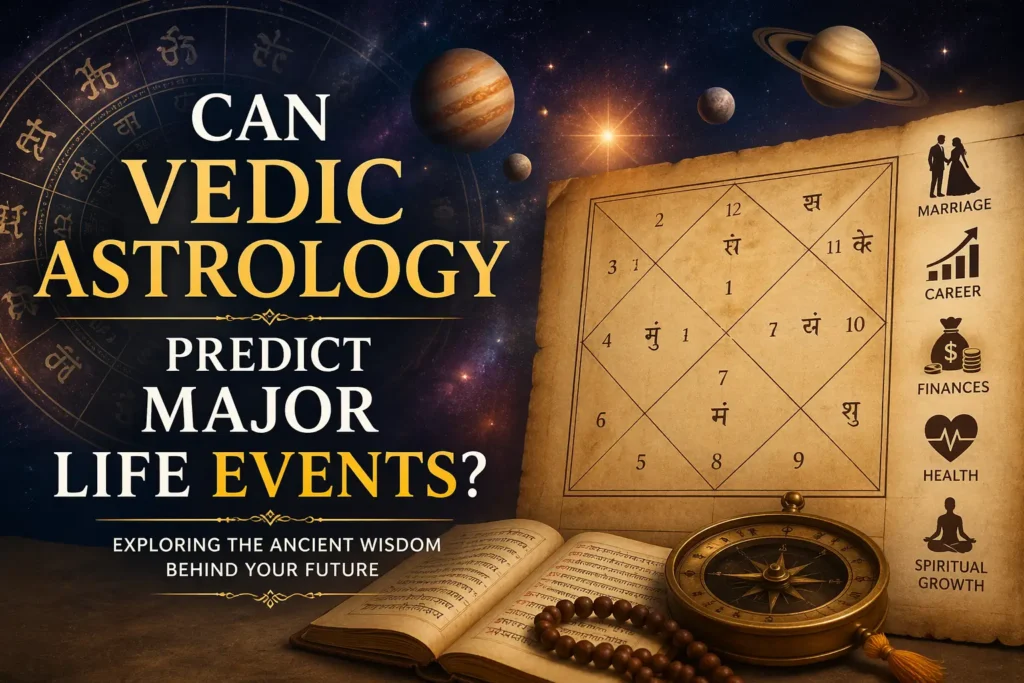
At the heart of Vedic astrology lies the concept that the positions of celestial bodies at the time of birth influence an individual’s life path. A birth chart, or kundli, maps the positions of planets across twelve houses and zodiac signs. Each house represents a different aspect of life such as relationships, career, wealth, and health.
The planets are not seen as causes but as indicators. They reflect karmic patterns carried from past actions and experiences. This means that Vedic astrology is deeply connected to the idea of karma. It suggests that major life events are not random but unfold according to a larger cosmic order.
The Role of Planetary Periods (Dashas)
One of the most powerful tools in Vedic astrology for predicting major life events is the system of planetary periods known as dashas. The most widely used system is the Vimshottari Dasha, which divides a person’s life into periods ruled by different planets.
Each dasha activates specific themes based on the planet’s placement in the birth chart. For example:
- A Venus dasha may bring focus on relationships, luxury, and creativity
- A Saturn dasha may bring discipline, delays, or significant life restructuring
- A Jupiter dasha often indicates growth, learning, and expansion
Within each major period, there are sub-periods that further refine timing. Astrologers analyze these layers to determine when certain life events are more likely to manifest.
Transits: Timing the Triggers
While dashas set the stage, planetary transits act as triggers. Transits refer to the current movement of planets in the sky and how they interact with the natal chart.
For instance, when a slow-moving planet like Saturn or Jupiter transits over key points in the chart, it can activate important life changes. Saturn transits often coincide with periods of responsibility, challenges, or maturity, while Jupiter transits tend to bring opportunities and growth.
A well-known example is the Saturn return, which occurs approximately every 29.5 years. This phase often marks a major turning point in life, involving career shifts, relationship changes, or personal transformation.
Can Major Life Events Be Predicted?
Vedic astrology can indicate the likelihood and timing window of major life events, but it does not guarantee exact outcomes. It works more like a weather forecast than a fixed script.
Here are some areas where Vedic astrology is often used to anticipate major events:
1. Marriage and Relationships
Astrologers examine the seventh house, its ruling planet, and Venus (for men) or Jupiter (for women, traditionally) to assess relationship potential. Favorable dashas and transits can indicate periods when marriage is more likely.
However, astrology cannot determine the exact identity of a partner or the precise circumstances. It highlights timing and tendencies rather than specifics.
2. Career and Professional Growth
The tenth house and its ruler play a key role in career predictions. When favorable planetary periods align with supportive transits, individuals may experience promotions, job changes, or business success.
On the other hand, challenging periods may bring setbacks that ultimately lead to long-term growth.
3. Financial Changes
The second and eleventh houses are associated with wealth and income. Strong planetary influences during certain dashas can signal financial gains, investments, or windfalls.
Conversely, difficult periods may require careful financial planning and discipline.
4. Health and Well-being
Health-related events are often linked to the sixth, eighth, and twelfth houses. Certain planetary combinations can indicate periods of vulnerability, while others suggest recovery and vitality.
Astrology in this context is often used as a preventive tool rather than a diagnostic one.
5. Major Life Transformations
Some planetary alignments, especially involving Saturn, Rahu, or Ketu, can bring profound changes. These may include relocation, spiritual awakening, or shifts in life direction.
Such events may feel sudden but are often part of a larger karmic cycle reflected in the chart.
The Limits of Prediction
It’s important to approach Vedic astrology with realistic expectations. While it can provide valuable insights, it has limitations:
Free Will Still Matters
Vedic astrology acknowledges the role of human effort, known as purushartha. Even if a chart shows challenging periods, individual choices can influence outcomes.
For example, a difficult career phase indicated in the chart may be transformed through hard work, skill development, or strategic decisions.
Interpretation Varies
Astrology is both a science and an art. Different astrologers may interpret the same chart differently based on their experience and approach. This means predictions are not always consistent.
Not Every Detail Can Be Foreseen
Astrology is better at identifying broad trends rather than specific details. It can indicate a period of relationship activity, but not necessarily whether it will be a marriage, breakup, or new partnership without deeper context.
Why People Still Rely on Vedic Astrology
Despite its limitations, Vedic astrology remains widely trusted for several reasons:
- It provides a sense of timing and preparedness
- It helps individuals understand recurring patterns in life
- It offers guidance during uncertain periods
- It connects personal experiences to a larger cosmic framework
Many people find comfort in knowing that difficult phases are temporary and part of a cycle.
Using Astrology Wisely
To get the most value from Vedic astrology, it should be used as a guide rather than a rigid predictor. Here are some practical ways to approach it:
Focus on Timing, Not Fear
Instead of worrying about negative predictions, use astrology to identify the best times for action. For example, starting a new venture during a favorable period can increase chances of success.
Combine Insight with Action
Astrology can highlight opportunities, but it is up to the individual to act on them. A strong career period will not automatically bring success without effort.
Seek Experienced Guidance
A knowledgeable astrologer can provide balanced insights, avoiding extreme or fear-based interpretations.
Keep Perspective
Life is influenced by many factors beyond astrology, including environment, education, and personal choices. Astrology is one tool among many.
Conclusion
So, can Vedic astrology predict major life events? The honest answer is that it can indicate them with reasonable accuracy in terms of timing and themes, but it cannot predict them with absolute certainty or detail.
It works best as a roadmap rather than a script. By analyzing planetary periods, transits, and the birth chart, Vedic astrology can highlight periods when important events are more likely to occur. However, how those events unfold depends on individual choices, circumstances, and actions.
In essence, Vedic astrology offers a blend of destiny and free will. It shows the patterns and possibilities, but the final outcome is shaped by how one navigates them. When used thoughtfully, it can be a powerful tool for self-awareness, planning, and personal growth.