How Retrograde Planets Actually Affect You

If you’ve spent any time around astrology—especially online—you’ve probably heard someone blame a bad week on a planet going retrograde. The most famous culprit is Mercury retrograde, often accused of causing everything from missed emails to broken relationships. But what does “retrograde” really mean, and more importantly, how does it actually affect you?
To understand this properly, we need to move beyond memes and superstition and look at retrogrades through the lens of traditional Vedic and Western astrology, psychology, and real-life patterns.
In this post, we will be able to learn and understand how retrograde planets actually affect you.
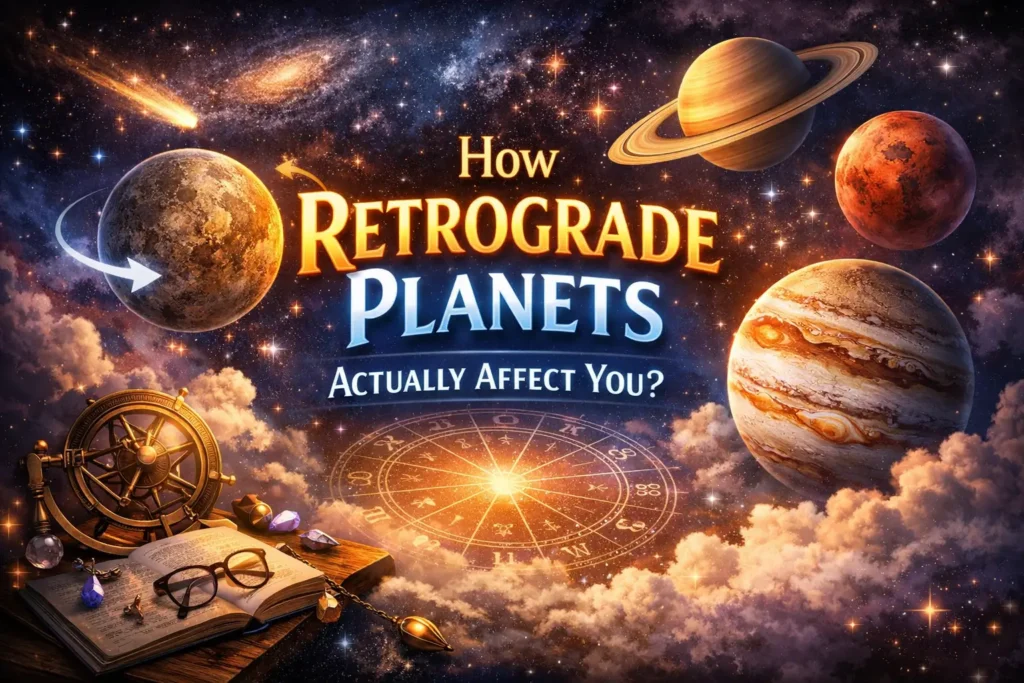
What Is a Retrograde Planet?
Astronomically, a retrograde planet is not actually moving backward in space. It only appears to move backward from Earth due to differences in orbital speed. This optical illusion has fascinated astrologers for centuries.
Astrologically, however, this apparent backward motion carries symbolic meaning. A retrograde planet represents:
- Reversal
- Reflection
- Internalization
- Reworking unfinished themes
Rather than straightforward outward expression, the energy of the planet turns inward or becomes irregular.
The Core Idea: Energy Turns Inward
In astrology, every planet represents a specific type of energy:
- Mercury → communication, thinking
- Venus → love, relationships
- Mars → action, drive
- Jupiter → growth, wisdom
- Saturn → discipline, structure
When a planet goes retrograde, its usual outward expression becomes less direct. Instead, you may experience:
- Delays instead of smooth progress
- Reconsideration instead of certainty
- Internal processing instead of external action
This is the key: retrogrades are not inherently negative. They are periods of recalibration.
Why Retrogrades Feel Disruptive
People often report confusion, frustration, or stagnation during retrogrades. This happens because modern life is built on constant forward motion—quick decisions, rapid communication, immediate results.
Retrogrades interrupt that rhythm.
They force you to:
- Slow down
- Re-evaluate decisions
- Fix what was overlooked
- Revisit unresolved situations
In other words, retrogrades expose what you skipped when you were moving too fast.
Mercury Retrograde: The Most Talked-About Influence
Mercury retrograde happens about three to four times a year, which is why it gets so much attention.
What Mercury Governs:
- Communication
- Technology
- Travel
- Contracts
- Thinking patterns
Common Experiences:
During Mercury retrograde, you might notice:
- Miscommunication (texts misunderstood, emails lost)
- Technical issues (devices malfunctioning)
- Travel disruptions (delays, cancellations)
- Old conversations resurfacing
But here’s the deeper truth: Mercury retrograde doesn’t create problems—it reveals weak points in communication and planning.
If something breaks, it was already fragile.
Retrogrades Are Not “Bad Luck”
One of the biggest misconceptions is that retrogrades bring bad luck. That’s not accurate.
Retrogrades highlight areas where:
- You rushed decisions
- You ignored details
- You avoided closure
- You need deeper understanding
They act more like a review system than a punishment.
Think of it like editing a document. The first draft might look fine, but when you review it, you notice mistakes. Retrogrades are that review phase.
How Different Retrograde Planets Affect You
Each planet’s retrograde has a unique psychological and practical effect.
Venus Retrograde: Relationships and Self-Worth
When Venus goes retrograde, themes around love, attraction, and values become more complex.
You might experience:
- Reconnection with past partners
- Doubts about current relationships
- Changes in what you find attractive
- Financial reassessment
This is not the best time for impulsive romantic decisions. Instead, it’s a time to understand what you truly value in relationships.
Mars Retrograde: Action and Motivation
Mars governs energy, ambition, and drive. When retrograde, it can feel like your momentum is blocked.
Common effects:
- Frustration without clear direction
- Reduced motivation
- Passive-aggressive behavior
- Delayed progress in goals
Mars retrograde asks you to reconsider how you act, not just what you pursue.
Jupiter Retrograde: Inner Growth
Jupiter represents expansion, learning, and belief systems.
When retrograde:
- Growth becomes internal
- External success may slow down
- You question beliefs and philosophies
- You seek deeper meaning rather than surface-level achievement
It’s less about gaining more and more and more about understanding what you already have.
Saturn Retrograde: Responsibility and Reality Checks
Saturn is about discipline, structure, and karma.
During retrograde:
- Old responsibilities resurface
- Past mistakes demand attention
- You reflect on long-term commitments
- You feel the weight of unfinished duties
This period is about accountability and long-term correction.
The Psychological Impact of Retrogrades
Beyond astrology, retrogrades align closely with psychological patterns.
Humans naturally go through cycles of:
- Action → Reflection → Adjustment
Retrogrades correspond to the reflection phase.
During these periods, you may feel:
- More introspective
- Less decisive
- Emotionally triggered by past events
- Drawn to unfinished business
This is not a coincidence. It’s a structured pause that allows mental and emotional processing.
Why the Past Comes Back
A common retrograde theme is the return of the past—old relationships, unresolved conflicts, forgotten opportunities.
This happens because retrogrades activate:
- Memory
- Emotional residue
- Unfinished cycles
If something returns during a retrograde, it usually means:
- It wasn’t fully resolved
- You didn’t learn the lesson
- Closure was incomplete
Retrogrades don’t bring random people back. They bring back incomplete stories.
How Retrogrades Affect You Personally
Not everyone experiences retrogrades the same way.
The impact depends on:
- Your birth chart
- Which house does the retrograde occur in
- Your current life situation
- Your level of awareness
For example:
- Mercury retrograde in your career sector may affect work communication
- Venus retrograde in your relationship sector may affect your love life
Astrology is not one-size-fits-all. The general themes apply, but the details are personal.
Practical Ways to Handle Retrogrades
Instead of fearing retrogrades, you can use them effectively.
1. Slow Down
Avoid rushing major decisions unless necessary. Double-check details.
2. Review and Revise
Go back to unfinished projects. Improve what already exists.
3. Communicate Clearly
Especially during Mercury retrograde, clarity matters more than speed.
4. Avoid Impulsive Changes
Major commitments (relationships, contracts, big purchases) should be approached carefully.
5. Reflect Instead of Reacting
Retrogrades often trigger emotional responses. Take time before acting.
The Hidden Advantage of Retrogrades
While many people see retrogrades as obstacles, they actually offer a powerful advantage: correction.
Without retrogrades:
- You might repeat the same mistakes
- You might ignore deeper issues
- You might move forward without understanding
Retrogrades create checkpoints in life.
They ensure that growth is not just fast—but meaningful.
Are Retrogrades Really Causing Events?
This is an important question.
Retrogrades don’t force events to happen. Instead, they:
- Align with natural cycles of reflection
- Amplify existing patterns
- Make underlying issues more visible
If your communication is already weak, Mercury retrograde exposes it.
If your relationship has unresolved tension, Venus retrograde highlights it.
The planet is not causing chaos—it’s revealing truth.
The Role of Awareness
The more aware you are of retrograde cycles, the less disruptive they feel.
People who understand retrogrades tend to:
- Plan more carefully
- Reflect more deeply
- React less impulsively
- Use the time productively
Awareness transforms retrogrades from stressful periods into strategic opportunities.
Retrogrades in Vedic vs Western Astrology
Both systems recognize retrogrades, but their interpretations differ slightly.
In Western Astrology:
- Retrogrades are often seen as psychological and reflective
- Focus is on internal processing and behavioral patterns
In Vedic Astrology:
- Retrograde planets (Vakri Grahas) are considered powerful
- Their effects can be intensified or unpredictable
- They may give delayed but strong results
In both systems, the core idea remains the same: retrogrades are about revisiting and reworking.
Final Thoughts: A Different Perspective
Retrograde planets are often misunderstood because they disrupt comfort.
They slow things down. They bring back the past. They force reflection.
But if you look closely, they’re not obstacles—they’re corrections.
They give you a chance to:
- Fix mistakes
- Understand yourself better
- Strengthen weak areas
- Complete unfinished chapters
Instead of asking, “Why is everything going wrong?” during a retrograde, a better question is:
“What is this trying to show me?”
Because that’s what retrogrades actually do—they show you what you missed the first time.
And that insight, if used well, can be far more valuable than smooth, uninterrupted progress.