How Sanatan Dharma Guides the Journey of the Soul

One of the most profound teachings of Sanatan Dharma is that life is not limited to birth and death. According to Hindu philosophy, every living being possesses an eternal soul, known as the Atman, which continues its journey beyond the physical body.
The human body may change, grow old, and eventually perish, but the soul is considered eternal and indestructible. The journey of the soul is shaped by karma, dharma, spiritual growth, and the cycle of rebirth. Ultimately, the highest purpose of this journey is to attain Moksha, or liberation from the continuous cycle of birth and death.
Sanatan Dharma provides a comprehensive spiritual framework that helps individuals understand who they are, why they are here, and what happens after death. Through sacred scriptures, spiritual practices, meditation, devotion, selfless action, and the guidance of a Guru, an individual can gradually progress toward self-realization.
This article explores how Sanatan Dharma guides the journey of the soul, from its association with the physical body to its ultimate goal of spiritual liberation.
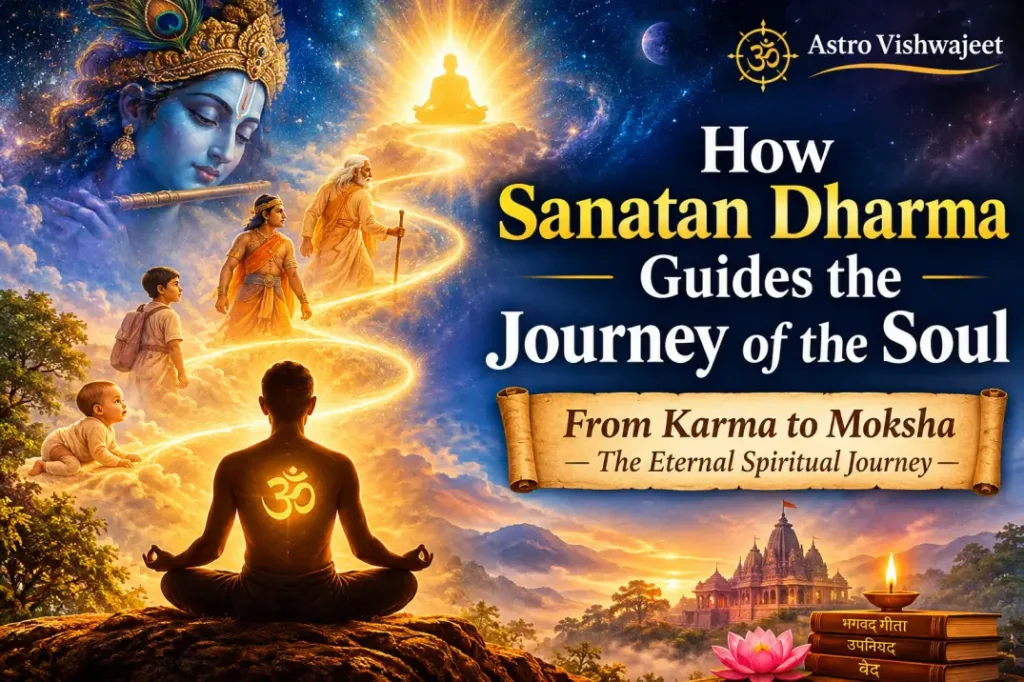
What Is the Soul According to Sanatan Dharma?
In Sanatan Dharma, the soul is known as the Atman. The Atman represents the true spiritual essence of an individual. Unlike the body and mind, which are temporary and constantly changing, the Atman is eternal.
The teachings of the Bhagavad Gita explain that the soul is neither born nor does it die. Physical bodies may be destroyed, but the true Self continues to exist.
This understanding creates an important distinction between the body and the soul.
The body is temporary.
The mind is constantly changing.
Emotions come and go.
Thoughts change from moment to moment.
However, the Atman remains eternal.
Sanatan Dharma teaches that much of human suffering comes from identifying completely with the body, possessions, social status, and temporary experiences. Spiritual growth begins when an individual starts asking deeper questions such as:
- Who am I beyond my physical identity?
- What is the purpose of my life?
- Why do human beings experience happiness and suffering?
- What happens to the soul after death?
- How can I attain spiritual liberation?
These questions form the foundation of the soul’s spiritual journey.
The Cycle of Samsara: Birth, Death and Rebirth
A central concept in Sanatan Dharma is Samsara, the continuous cycle of birth, death, and rebirth.
According to Hindu philosophy, the soul does not experience only one lifetime. Instead, it travels through numerous births and experiences. Each lifetime provides opportunities for learning, growth, and spiritual evolution.
When the physical body dies, the soul continues its journey and eventually takes another birth according to various spiritual factors, particularly karma.
The cycle can be understood as:
Birth → Life → Death → Rebirth → Spiritual Evolution
The circumstances of each life provide experiences that help the soul learn important spiritual lessons.
Some individuals may experience comfort and prosperity, while others may face significant challenges. Sanatan Dharma encourages people to understand life through a deeper spiritual perspective rather than assuming that every experience is random.
However, the purpose of spiritual understanding is not to become passive or indifferent to suffering. Instead, it encourages individuals to respond to life with wisdom, compassion, responsibility, and awareness.
The ultimate goal is to transcend Samsara and attain Moksha.
The Role of Karma in the Journey of the Soul
The law of Karma plays an essential role in understanding the journey of the soul.
Karma simply means action, but in spiritual philosophy, it also refers to the consequences generated by actions, intentions, and choices.
Every action creates an impression and produces results. Positive actions can create beneficial consequences, while harmful actions can create suffering.
Karma is not simply a system of punishment and reward. It is closely connected with the principle of cause and effect.
For example, a person who develops qualities such as:
- Compassion
- Honesty
- Self-discipline
- Generosity
- Kindness
- Spiritual awareness
moves toward greater inner growth.
On the other hand, actions motivated by excessive anger, greed, hatred, selfishness, and ignorance can create further bondage.
Sanatan Dharma teaches that individuals should become conscious of their actions and intentions. Spiritual progress requires taking responsibility for one’s life while understanding that every person has the ability to make better choices.
The journey of the soul is therefore deeply connected with the gradual purification of one’s thoughts, actions, and consciousness.
Dharma: The Spiritual Path of Right Living
While karma explains the consequences of actions, Dharma provides guidance regarding how a person should live.
Dharma can be understood as righteous living, duty, moral responsibility, and living in harmony with truth and cosmic order.
Every individual has responsibilities toward:
- Family
- Society
- Nature
- Other living beings
- Their own spiritual development
Living according to Dharma helps create balance in both individual and collective life.
Sanatan Dharma does not encourage spiritual growth only through rituals or meditation. Everyday actions are also part of the spiritual path.
A person can follow Dharma by practicing:
- Truthfulness
- Compassion
- Respect for others
- Self-control
- Non-violence
- Responsibility
- Service to humanity
When daily life becomes guided by Dharma, ordinary actions can become part of the soul’s spiritual evolution.
The journey toward liberation does not necessarily require abandoning the world. Instead, Sanatan Dharma teaches that individuals can perform their duties while gradually reducing attachment to the results of their actions.
The Four Purusharthas and the Purpose of Human Life
Sanatan Dharma provides another important framework known as the Four Purusharthas, or the four primary goals of human life.
These are:
1. Dharma
Dharma represents righteous living, moral responsibility, and spiritual duty.
2. Artha
Artha refers to material prosperity and the resources necessary for a stable and responsible life.
3. Kama
Kama represents desires, enjoyment, emotional fulfillment, and appreciation of life’s experiences within the boundaries of Dharma.
4. Moksha
Moksha is liberation from spiritual ignorance and the cycle of birth and death.
These four goals show that Sanatan Dharma does not reject worldly life completely. Material success and personal happiness can have a place in life when pursued responsibly and ethically.
However, Moksha remains the highest spiritual objective because it represents freedom from ignorance and attachment.
This balanced approach helps guide the soul through the different stages of life while gradually directing consciousness toward spiritual realization.
Reincarnation and the Evolution of Consciousness
The concept of reincarnation is closely connected with the journey of the soul.
According to many Hindu philosophical traditions, the soul takes different bodies as it continues its journey through Samsara. Each birth provides new circumstances and opportunities for spiritual development.
Human birth is considered especially significant because it provides the ability to:
- Question the nature of existence
- Develop spiritual awareness
- Practice self-discipline
- Seek truth
- Perform conscious actions
- Pursue liberation
The soul’s journey is therefore not simply about moving from one life to another. It is also about the evolution of consciousness.
Through different experiences, an individual gradually develops greater wisdom and understanding.
Difficult experiences can teach patience and strength. Relationships can teach love and compassion. Success can teach responsibility, while failure can teach humility.
From a spiritual perspective, life becomes a field of learning.
The important question is not simply, “Why is this happening to me?” but also, “What can I learn and how can I grow through this experience?”
The Three Gunas and Their Influence on the Soul
Sanatan Dharma also explains human nature through the concept of the Three Gunas:
- Sattva
- Rajas
- Tamas
These qualities influence the mind and personality.
Sattva: Purity and Harmony
Sattva is associated with wisdom, peace, clarity, compassion, and spiritual awareness.
A sattvic lifestyle encourages activities such as meditation, selfless service, spiritual study, and living with moderation.
Rajas: Activity and Desire
Rajas is associated with activity, ambition, desire, restlessness, and attachment.
Rajas can motivate individuals to achieve goals, but excessive rajas can create stress and constant dissatisfaction.
Tamas: Inertia and Ignorance
Tamas is associated with ignorance, laziness, confusion, and inactivity.
When tamas dominates the mind, individuals may struggle to recognize their higher purpose.
Spiritual practices help an individual gradually move from tamas toward rajas and eventually toward sattva.
However, the ultimate spiritual goal is to go beyond complete identification with all three Gunas and realize the true nature of the Atman.
The Four Paths of Yoga and Spiritual Liberation
Sanatan Dharma recognizes that people have different personalities and spiritual inclinations. For this reason, Hindu philosophy provides multiple paths toward spiritual realization.
Karma Yoga: The Path of Selfless Action
Karma Yoga teaches individuals to perform their duties without excessive attachment to the results.
Instead of constantly thinking about personal rewards, a person learns to act with sincerity and offer their actions as a form of spiritual practice.
Selfless service helps reduce ego and attachment.
Bhakti Yoga: The Path of Devotion
Bhakti Yoga is the path of love and devotion toward the Divine.
Through prayer, chanting, worship, and remembrance of God, the heart gradually becomes purified.
Bhakti teaches that love for the Divine can transform the consciousness of an individual.
Jnana Yoga: The Path of Knowledge
Jnana Yoga focuses on spiritual knowledge and self-inquiry.
The seeker investigates questions such as:
- Who am I?
- What is the true nature of reality?
- What is the relationship between Atman and Brahman?
Through deep contemplation and spiritual wisdom, the seeker attempts to overcome ignorance.
Raja Yoga: The Path of Meditation and Discipline
Raja Yoga emphasizes control of the mind through ethical discipline, concentration, and meditation.
The restless mind is gradually brought toward stillness.
Meditation helps individuals move beyond temporary thoughts and experience deeper levels of awareness.
These paths demonstrate that Sanatan Dharma provides multiple approaches to spiritual growth.Moksha: The Ultimate Goal of the Soul
The ultimate destination of the soul’s spiritual journey is Moksha.
Moksha means liberation from the cycle of Samsara and freedom from spiritual ignorance.
It is associated with the realization of one’s true nature.
According to different schools of Hindu philosophy, Moksha may be understood in different ways, but it generally represents the highest state of spiritual freedom.
A liberated individual is no longer completely controlled by:
- Fear
- Attachment
- Ego
- Ignorance
- Endless desires
Moksha is not simply a reward received after death. It is deeply connected with the transformation of consciousness.
A person who develops spiritual wisdom can experience greater freedom even while living in the world.
The journey toward Moksha involves recognizing that external possessions and temporary experiences cannot provide permanent fulfillment.
True peace comes from spiritual realization.
The Importance of a Guru in the Soul’s Journey
In Sanatan Dharma, the Guru is often regarded as an important guide on the spiritual path.
Spiritual knowledge can be studied through scriptures, but personal guidance can help individuals understand how spiritual principles apply to their own lives.
A true Guru helps the seeker:
- Develop spiritual discipline
- Understand sacred teachings
- Overcome ignorance
- Strengthen faith
- Develop self-awareness
- Progress on the path of realization
The Guru is traditionally respected as someone who helps remove the darkness of ignorance and guides the seeker toward knowledge.
However, spiritual seekers are also encouraged to develop discernment and sincerity.
The ultimate purpose of spiritual guidance is to help an individual recognize the truth within themselves.
Spiritual Practices That Support the Soul’s Journey
Sanatan Dharma offers many practices that can support spiritual growth.
Meditation
Meditation helps calm the mind and develop inner awareness.
Japa and Mantra Chanting
Repeating sacred mantras can help improve concentration and strengthen spiritual focus.
Prayer and Worship
Prayer and worship provide a way to develop devotion and gratitude.
Seva or Selfless Service
Serving others without selfish expectations helps reduce ego and develop compassion.
Study of Sacred Scriptures
Studying texts such as the Bhagavad Gita and Upanishads can provide spiritual knowledge and guidance.
Satsang
Spending time with spiritually minded individuals can positively influence one’s thoughts and actions.
Living a Dharmic Life
Spirituality is not limited to temples or meditation. Truthfulness, kindness, responsibility, and compassion are also important spiritual practices.
When practiced consistently, these disciplines can gradually transform the mind and support the soul’s journey toward higher awareness.
Death Is a Transition, Not the End
One of the most comforting spiritual teachings of Sanatan Dharma is that death is not considered the end of existence.
The physical body eventually returns to nature, but the Atman is regarded as eternal.
This perspective encourages individuals to understand death as a transition rather than complete destruction.
At the same time, Sanatan Dharma does not suggest that people should ignore the value of human life.
Human life is considered precious because it provides an opportunity for spiritual growth and self-realization.
Understanding the temporary nature of the body can encourage people to live with greater awareness.
Instead of becoming completely absorbed in temporary achievements, individuals can ask:
- Am I living according to my values?
- Am I fulfilling my responsibilities?
- Am I becoming a better person?
- Am I growing spiritually?
- What is the deeper purpose of my life?
These questions can transform the way a person approaches everyday life.
How Sanatan Dharma Helps Us Live With Greater Purpose
The teachings of Sanatan Dharma are not only concerned with what happens after death. They also provide guidance for living a meaningful life in the present.
The journey of the soul becomes clearer when individuals begin to:
- Understand the temporary nature of material life
- Take responsibility for their actions
- Follow Dharma
- Practice compassion
- Reduce unhealthy attachments
- Develop spiritual awareness
- Serve others
- Seek knowledge and truth
- Remember the higher purpose of human life
Spiritual growth does not happen overnight.
It is a gradual process of learning, reflection, discipline, and transformation.
Every experience can become part of the spiritual journey when approached with awareness.
Conclusion: The Eternal Journey Toward Liberation
Sanatan Dharma offers a profound understanding of the journey of the soul. It teaches that the Atman is eternal, while the physical body is temporary. Through the cycle of Samsara, the soul experiences different stages of existence and continues to evolve through karma and spiritual growth.
Dharma provides guidance for righteous living, while the paths of Yoga offer practical methods for spiritual realization. Meditation, devotion, selfless service, knowledge, and disciplined living all help purify the mind and reduce attachment.
Ultimately, the highest goal is Moksha, liberation from ignorance and the cycle of birth and death.
The teachings of Sanatan Dharma encourage us to look beyond temporary identities and material achievements and discover the deeper reality within ourselves.
The journey of the soul is not merely about reaching a destination after death. It is also about how we live today.
Every act of kindness, every effort toward self-improvement, every moment of spiritual awareness, and every sincere search for truth can become part of the journey toward higher consciousness.
By understanding the principles of Atman, Karma, Dharma, Samsara, Yoga, and Moksha, individuals can approach life with greater clarity and purpose.
In this way, Sanatan Dharma continues to guide the eternal journey of the soul, from ignorance toward knowledge, from attachment toward freedom, and ultimately from the cycle of rebirth toward spiritual liberation.
Frequently Asked Questions
What is the journey of the soul according to Sanatan Dharma?
According to Sanatan Dharma, the soul is eternal and continues its journey through the cycle of birth, death, and rebirth. Its experiences are influenced by karma and spiritual development, with Moksha being the ultimate goal.
What is Samsara in Hindu philosophy?
Samsara is the continuous cycle of birth, death, and rebirth. The soul remains within this cycle until spiritual liberation is attained.
How does karma affect the soul?
Karma refers to actions and their consequences. A person’s actions and intentions influence their experiences and spiritual development.
What is Moksha?
Moksha is liberation from the cycle of birth and death and freedom from spiritual ignorance and attachment.
How can a person progress spiritually in Sanatan Dharma?
Spiritual progress can be supported through meditation, devotion, selfless service, spiritual knowledge, ethical living, mantra chanting, and following Dharma.
Is death considered the end according to Sanatan Dharma?
No. According to Hindu spiritual philosophy, the physical body dies, but the Atman is considered eternal and continues its spiritual journey.